


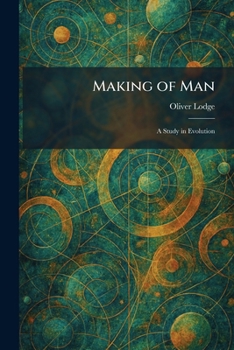
Making of Man: A Study in Evolution

Select Format
Select Condition 
Book Overview
"Making of Man: A Study in Evolution" is a profound exploration of humanity's origins and destiny, written by the eminent physicist and thinker Sir Oliver Lodge. In this work, Lodge moves beyond a purely biological interpretation of Darwinian theory to examine evolution as a grand, purposeful process that encompasses both the physical and spiritual realms. He argues that the development of the human species is not a finished chapter but a continuing progression toward higher states of consciousness and existence.
Lodge addresses the perceived conflict between scientific inquiry and spiritual belief, seeking to reconcile the mechanical laws of nature with the persistence of the human soul. The book delves into the nature of life, the emergence of mind, and the ultimate purpose of the universe. By synthesising scientific rigour with a visionary outlook on the potential for human growth, Lodge provides a compelling narrative of progress. "Making of Man: A Study in Evolution" remains a significant historical text for those interested in the history of science, the philosophy of biology, and the early twentieth-century effort to bridge the gap between materialist science and spiritual philosophy.
This work has been selected by scholars as being culturally important, and is part of the knowledge base of civilization as we know it. This work was reproduced from the original artifact, and remains as true to the original work as possible. Therefore, you may see the original copyright references, library stamps (as most of these works have been housed in our most important libraries around the world), and other notations in the work.
This work is in the public domain in the United States of America, and possibly other nations. Within the United States, you may freely copy and distribute this work, as no entity (individual or corporate) has a copyright on the body of the work.
As a reproduction of a historical artifact, this work may contain missing or blurred pages, poor pictures, errant marks, etc. Scholars believe, and we concur, that this work is important enough to be preserved, reproduced, and made generally available to the public. We appreciate your support of the preservation process, and thank you for being an important part of keeping this knowledge alive and relevant.
Customer Reviews
ThriftBooks ® and the ThriftBooks ® logo are registered trademarks of Thrift Books Global, LLC
