


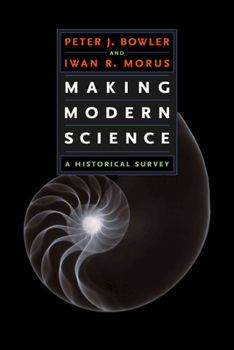
Making Modern Science: A Historical Survey


Select Format
Select Condition 
Book Overview
The development of science, according to respected scholars Peter J. Bowler and Iwan Rhys Morus, expands our knowledge and control of the world in ways that affect-but are also affected by-society and culture. In Making Modern Science, a text designed for introductory college courses in the history of science and as a single-volume introduction for the general reader, Bowler and Morus explore both the history of science itself and its influence on modern thought. Opening with an introduction that explains developments in the history of science over the last three decades and the controversies these initiatives have engendered, the book then proceeds in two parts. The first section considers key episodes in the development of modern science, including the Scientific Revolution and individual accomplishments in geology, physics, and biology. The second section is an analysis of the most important themes stemming from the social relations of science-the discoveries that force society to rethink its religious, moral, or philosophical values. Making Modern Science thus chronicles all major developments in scientific thinking, from the revolutionary ideas of the seventeenth century to the contemporary issues of evolutionism, genetics, nuclear physics, and modern cosmology. Written by seasoned historians, this book will encourage students to see the history of science not as a series of names and dates but as an interconnected and complex web of relationships between science and modern society. The first survey of its kind, Making Modern Science is a much-needed and accessible introduction to the history of science, engagingly written for undergraduates and curious readers alike.
Format:Paperback
Language:English
ISBN:0226068617
ISBN13:9780226068619
Release Date:April 2005
Publisher:University of Chicago Press
Length:529 Pages
Weight:1.64 lbs.
Dimensions:1.0" x 6.8" x 9.1"
Customer Reviews
1 rating
Dense but thorough and well laid out
Published by Thriftbooks.com User , 17 years ago
Bowler and Morus (B & M henceforth) set themselves two projects in this book. First, to create a general introductory overview of the history of science. Second, to introduce their reader (presumably an undergraduate history major) to arguments currently playing out amongst academics who study the history of science. They are pretty successful at both, although a reader who buys this book without already being aware of the academic controversies may occasionally be puzzled by some of the positions that B & M take. The tone is a bit dry and the number of facts per page can be overwhelming to someone who is learning this material for the first time. It's more of a textbook than a pleasure read. However, to my knowledge they have done an excellent job of covering relevant and significant people, events, connections to past knowledge, and social influences. On several occasions, their "conclusions" at the end of each chapter are unsupported (at least in this book) assertions rather than actual consequences of the evidence and arguments they cover. No doubt this is largely due to the difficulty of compressing 550 years of scientific discovery into a single volume. I consider this the chief weakness of the book. Otherwise, it accomplishes its intended purpose well. A professional historian will not need this book. A scientist or well educated layperson interested in history might find it overwhelming or simply too dense. But if you are looking for a middle ground between a completely academic volume and a pleasure read, or if you need a great bibliography or condensed summary volume, this is almost your only choice. Lucky for you it's well done.
Copyright © 2026 Thriftbooks.com Terms of Use
| Privacy Policy | Do Not
Sell/Share My Personal Information | Cookie Policy | Cookie Preferences | Accessibility Statement
ThriftBooks® and the ThriftBooks® logo are registered trademarks of Thrift Books Global, LLC
ThriftBooks® and the ThriftBooks® logo are registered trademarks of Thrift Books Global, LLC
