
Skip to content
Scan a barcode
Scan
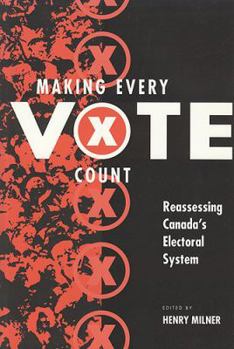
Paperback Making Every Vote Count: Reassing Canada's Electoral System Book

ISBN: 1551112566

ISBN13: 9781551112565

Making Every Vote Count: Reassing Canada's Electoral System

Steps Toward Making Every Vote Count brings together the best analyses from the best qualified observers on developments in the growing movement to reform Canada's electoral system.


Among mature democracies, only the United States and Canada use the first-past-the-post (FPTP) system for electing all state and provincial, as well as national, law makers. In Canada the debate over the electoral system, which began in earnest after the 1997 federal election, is now moving from the university and think-tank seminar room to the floor of five provincial legislatures.


Four key chapters present up-to-date accounts of developments in BC, Quebec, PEI, and Ontario. They show the provinces moving at different speeds toward meeting an objective to propose a specific model of proportional representation that also ensures a continued role for directly elected representatives of specific geographic boundaries. Two chapters recount experiences in New Zealand and Scotland, which adopted electoral plans attempting just such a balance. Others look at South Africa, Japan, Frances, and the United States - each selected for the light its casts on a specific aspect of electoral system reform. The remaining chapters consider various practical implications of changing Canada's electoral system - now a very real prospect.

Recommended

Format: Paperback

Temporarily Unavailable

We receive fewer than 1 copy every 6 months.

Save to List

Customer Reviews

1 rating

Even Seabiscuit Finished Out of the Money On Occasion . . .

And thus it is sad that more people have not read and discusssed MAKING EVERY VOTE COUNT. An Anglo-Parliamentary system such as Ireland's, the U.K.'s or Canada's has provenance in the old racing metaphor of "first past the post" meaning that substantial numbers of your non-dunderheaded neighbors may not be making their voices heard in Ottawa or the provincial capitals. Other Commonwealth countries are slowly beginning to adjust for that discrepancy, but not Canada. (An even more restrictive --and cautionary -- extreme example of non-proportional representation lies south of the border under the American "winner take all" system, which engenders the two-party "tradition" that is now quickly ossifying into a two-party fact due to the dual-edged hypocrisy of campaign "reform" that makes it ever harder for small parties like Greens or Libertarians to qualify for the ballot in fifty different states with fifty different sets of dates, quotas and rules to fill for ballot access. This effective duopoly of partisanship in no small part engenders the trite and condescending level of public discourse in the USA.) And in some ways, Canada's traditional curse has been her savior--at least until very recently. Conservative + Liberal + NDP plus Bloc meant 2-1/2 Anglo parties plus something for the French . . . until recently, when it becomes painfully apparent that the splintered post-Mulroney Conservatives can't get their act back together, and that the Chretien legacy just won't stop its slide from embarrassment into shame. The old solid and stolid Victorian equation of Gladstone vs. Disraeli (or Mackenzie and Macdonald) just isn't working. And that's a pity. It's worth remembering that in 1961 the NDP wasn't founded by just Ontario laborites but by Prairie radicals and a few old SoCreds from the coast. But the options like that are shrinking. Pre-Martin election polling consistently revealed that the public, especially voters born after 1950, want mostly the same things: keep Health Canada, cut out the waste and corruption, protect people's right and privacy and show tolerance in areas like gay weddings and home marijuana use (while recognizing those things are not earth-shaking issues). But it does appear to many, ever more bleakly, that the Parties are taking a cue somewhat like the Yanks: cut a moderate tone in campaign publicity, then go right out and revert to stereotype once you're safely back in power. In other words, tell the people what they want to hear, but don't really listen. Which is not a definition of democracy. I've lived in Germany and was deeply suspicious at first of proportional representation. At first, like many German citizens, I thought of the Greens as spoiled, upper-middle-class scolds, overprivileged tree-huggers who thought societal transformation was a matter of Blitz! Stop bleaching paper. Zap! Speed limits on the Autobahn. Real Mercedes Marxists, those kids. But they worked hard and lived out their scru
Copyright © 2026 Thriftbooks.com Terms of Use | Privacy Policy | Do Not Sell/Share My Personal Information | Cookie Notice | Cookie Preferences | Accessibility Statement
ThriftBooks ® and the ThriftBooks ® logo are registered trademarks of Thrift Books Global, LLC

GoDaddy Verified and Secured