


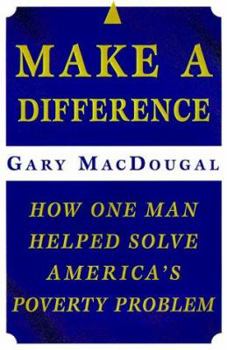
Make a Difference: How One Man Helped Solve America's Poverty Problem

The chairman of a task force to reform welfare in the state of Illinois shows how he helped welfare recipients become self-sufficient and how the state pried loose the dead hand of human service bureaucracies.
Format:Hardcover
Language:English
ISBN:0312252234
ISBN13:9780312252236
Release Date:February 2000
Publisher:Truman Talley Books
Length:384 Pages
Weight:1.62 lbs.
Dimensions:9.6" x 1.3" x 6.2"
Customer Reviews
3 ratings
Belying the Myths
Published by Thriftbooks.com User , 25 years ago
One of the happy lessons of the national welfare reform experiment is that the interests of the poor and the business community need not be at odds. Both business leaders and business practices have much to offer the reform effort. Gary MacDougal is a business leader who traveled far and worked doggedly to make his own powerfully constructive offer - and to make it concrete. In doing so, MacDougal belied the myth perpetuated by those who fret that business leaders poking around social welfare programs will focus only on cutting costs and will leave the poor stranded at the doors of shuttered programs. But that was not MacDougal's vision - far from it. In the midst of a successful business career, MacDougal went to Nepal and came down from the mountain with a desire to make a difference. After selling his business, he was free of all of the usual agendas -- whether of the left, right, party politics, turf, personal business interests, or a bureaucracy to defend, and he decided to make his contribution by offering a governor his help in leading a human services reform effort. The Governor said thanks, and MacDougal went on to challenge seven entrenched bureaucracies, the legislature, providers, and the unions. His good listening ear allowed him to hear fully from the clients of the system, as well as all the other players as they described (and often defended) the jumbled mess that called itself human services delivery. His heart told him there had to be a better way to serve families. And his business experience and acumen told him that the other way would have to be a customer first model that coordinated and redesigned the system based on the perspectives and needs of the communities to be served. His plan was adopted by Illinois, where he focused his efforts. It puts families first. It insists on seamless service delivery of services in a now-consolidated human services agency that he helped create shape. And his plan is grounded in a from-the-ground-up local systems design intended to respond to the unique needs of each community where services are delivered. Now that most welfare families with the fewest personal and social problems are working, other states would do well to look at MacDougal's model of coordinated service delivery to address the far more complex needs of those families who remain on welfare.-- This by an attorney who has represented the poor for twenty years.
A good story with policy wonk stuff, too
Published by Thriftbooks.com User , 25 years ago
This book speaks to more audiences than any other I've recently read.It is, as advertised, a story about what "welfare reform" means in one state (Illinois.) But its a lot more. It is the story of one man's late mid-life crisis and how he tries to make the world a better place. (Would that Steve Forbes read this book and decided to do something with a better chance of paying off than run for president.) Its a "true story of people in inner city" Chicago in the tradition of Alex Kotlowitz and Nick Lehmann. But its also the story of the people who make up the rules faced by those real people: the street level bureaucrats who make the rules into "yes" and "no" answers, the senior bureaucrats who are between the street level bureaucrats and the legislators who make the decisions.I especially liked having a state-level perspective on "how our laws are made." I haven't seen a book from a personal perspective as good as this since Eric Redman's "The Dance of Legislation." And its the first time I've seen one from a state-level perspective. (It will remind you all over again of why there is the adage: "Two things you don't want to see being made -- sausage and legislation.")
A Heart-Warming Success Story
Published by Thriftbooks.com User , 25 years ago
Too often, discussions of our welfare system are in an ideological context - the left or the right. In this splendid and highly readable book, Gary MacDougal shows that perhaps the too-long neglected pragmatic perspective is the most important.As a citizen-volunteer, Mr. MacDougal led the Governor's task force charged with fundamentally restructuring the Illinois welfare system, which administers a highly fragmented hodge-podge of state- and federally-funded programs. To this assignment he brought unique qualifications: He is an experienced and successful business executive. However, unlike many businessmen, he had enough political exposure to understand how things get done in the public sector. He is also a leader in the human services philanthropic sector. Finally, he took the time to go where few policy makers go, to meet the welfare "customers," and to learn first hand what happens at every level of the welfare system.Make no mistake about it, what Mr. MacDougal and his Illinois task force accomplished is truly historic. Over many decades, in the face of widely recognized flaws and inefficiencies in our welfare system, no other state has been able to implement such a far-reaching, systemic reform. They say that legislation (and government organization studies) are like sausage - watching either one of them being made is not a pretty sight. However, this compelling book is an engaging, even at times heart-warming saga that brings to life the complexities of government in the real world. Hopefully some readers will want to step up to be part of similar initiatives in their own states.In the end, one can't help but conclude that Mr. MacDougal's triumph was basically a tenacious exercise in common sense (albeit at the highest professional level!). Which raises the question, why doesn't the American electorate demand this level of common sense in other areas of public policy, rather than fifteen-second sound bites?
Copyright © 2026 Thriftbooks.com Terms of Use
| Privacy Policy | Do Not
Sell/Share My Personal Information | Cookie Policy | Cookie Preferences | Accessibility Statement
ThriftBooks® and the ThriftBooks® logo are registered trademarks of Thrift Books Global, LLC
ThriftBooks® and the ThriftBooks® logo are registered trademarks of Thrift Books Global, LLC
