


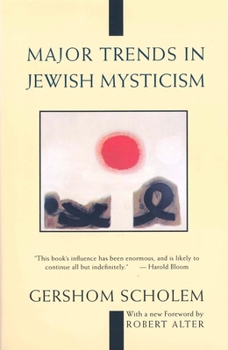
Major Trends in Jewish Mysticism

Select Format
Select Condition 
Book Overview
Revised
Format:Paperback
Language:English
ISBN:0805210423
ISBN13:9780805210422
Release Date:May 1995
Publisher:Knopf Doubleday Publishing Group
Length:496 Pages
Weight:1.00 lbs.
Dimensions:1.0" x 5.1" x 7.9"
Customer Reviews
3 ratings
THE Modern Classic of Kabbalah
Published by Thriftbooks.com User , 21 years ago
Gershom Scholem transformed Kabbalah into an acceptable academic discipline. Today many writers/scholars/professors follow in his footsteps (e.g. Wolfson and Idel). He, no doubt, did us a great service. It should be noted, however, that he was an historian--neither scientist nor Kabbalist. He appears to have faithfully presented Kabbalistic doctrines, teachings, etc. Nonetheless, the reader should be sensitive to a certain lack of scientific viewpoint on the one hand and mystical/experiential knowledge and orientation on the other--in all of his works. That said, this is a wonderful book, probably his best (certainly his most famous) and one of the best available today on Kabbalah per se. If you like this book, I'd recommend you also read, "Jewish Gnosticism-Merkabah Mysticism-and Talmudic Tradition," "On the Mystical Shape of the Godhead," and his voluminous entry in a Jewish Encyclopedia on Kabbalah published as a stand-alone volume entitled, "Kabbalah." Both this last work and "Major Trends" illuminate most of the main Kabbalistic concepts (e.g. the Shekinah, the female Presence or Immanence of God). Any serious student of Kabbalah will find the present work a necessary addition to his/her repertoire. It's probably the best known contemporary work on the subject. The historical data has great breadth and considerable depth. However, it does suffer from Scholem's lack of mystical or scientific background. For example, near the very front of the book, he asserts that no on would consider the prophets to be mystics. This is untrue. Since I consider it so (and he's broken the non-all ness principle), he is simply wrong. Since a mystic has direct knowledge or contact with God, and prophets have such, they are most definitely mystics. In set theory they would be a subset of mystics (a circle within a circle on a Venn Diagram). This does not, of course, imply that all mystics are prophets. My favorite quotation from this book is on page 229: "It says something for its [the conception of the Shekhinah as the feminine element in God] vitality that, despite the opposition of such powerful forces [the philosophers and the strict Talmudists as well], this idea became part and parcel of the creed of wide circles among the Jewish communities of Europe and the East." Thus, Scholem points out the innovative content of Kabbalah vs. normative, Rabbinical Judaism with its emphasis on the transcendence of a male God. This book is a close as you get to required reading in Kabbalah for both the scholar and the practitioner. After all, a mystic needs the balance of having his/her feet on the ground (of good scholarship=good theory) as well as his/her head in the clouds (of meditation and mystical attunement).
Thoroughly Enjoyable and Enlightening
Published by Thriftbooks.com User , 23 years ago
Although the print is kind of small and the notes are inconveniently at the end, this book is an excellent resource! I'm a Christian, and not a mystic. I bought this book to better understand some odd Christian teachings floating around in several modern church movements that I suspected, from other reading I'd done, are kabbalistic. The contents of this authorative book clearly delineate the relationship of Jewish mysticism and magic to the main features of these new Christian movements. (For instance, the current emphasis on holy spirit "anointings", visitations of the shekinah, and "the bride of Christ" clearly come from Judaica.) Christians interested in embracing their Hebrew roots need to read this, order to properly discern and divide what is scripture from what is tradition. (A copy of Abraham Cohen's "Everyman's Talmud" is very helpful too!)Despite the esoteric topics, Gershom Scholem is fairly easy to understand, and the book is organized into logical topics. It also has a good index and tons of bibliographical references. A must for your reference shelf.
The Screwball Kabbalah
Published by Thriftbooks.com User , 25 years ago
With these nine snapshots of Great Moments in Jewish Mysticism, Scholem gives an amazing crash course in an immense & complex spiritual tradition. His chapter on the Zohar is especially helpful, with concise explanations of tricky concepts like Sefiroth and the Shekinah, God's female aspect (I had no idea! Though since reading this I've heard Leonard Nimoy say that he copped Spock's split-finger greeting from synagogue, where it signaled the Shekinah's presence).Scholem's affection for the Kabbalists stems from his belief that they kept alive a mythic, almost pantheistic, vision of God against the more rationalizing tendencies of mainstream Judaism. The mystics as he describes them, despite their arcane systems, were closer to popular beliefs and aspirations than the 'official' rabbinical tradition. In 1938, when Scholem gave these lectures, he hoped for a spiritual revival from within Jewish mysticism at a moment of crisis. I don't know if the New Age hipness of the Kabbalah was what he had in mind, but for all the measured, scholarly prose his heart is clearly with the weirdos. I knew almost nothing about Jewish mysticism going into this book. I put it down with a new respect for one of the human mind's more intricate and neglected creations.
Copyright © 2026 Thriftbooks.com
Terms of Use | Privacy Policy | Do Not Sell/Share My Personal Information | Cookie Policy | Cookie Preferences | Accessibility Statement
ThriftBooks ® and the ThriftBooks ® logo are registered trademarks of Thrift Books Global, LLC
ThriftBooks ® and the ThriftBooks ® logo are registered trademarks of Thrift Books Global, LLC
