


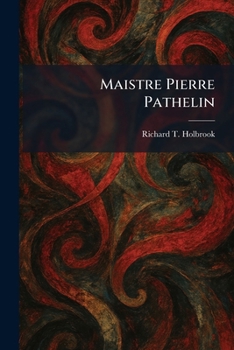
Maistre Pierre Pathelin

Select Format
Select Condition 
Book Overview
"Maistre Pierre Pathelin" stands as the preeminent masterpiece of late medieval French farce, a genre-defining work that has influenced European comedy for centuries. This anonymous 15th-century play follows the eponymous Maistre Pierre Pathelin, a cunning but destitute lawyer who uses his linguistic prowess and sharp wit to swindle a local draper out of expensive cloth. The narrative takes an ironic turn when Pathelin defends a shepherd in court, teaching his client a deceptive tactic that ultimately leads to the lawyer's own undoing. This classic of social satire offers a biting critique of the legal system and the hypocrisies of various social classes, all while delivering a fast-paced and hilariously cynical plot.
In this edition prepared by Richard T. Holbrook, the text is presented with meticulous attention to its linguistic and historical context. The work remains a vital study of the transition from medieval to Renaissance literary forms, showcasing the evolution of character-driven comedy and the sophisticated use of irony and wordplay. "Maistre Pierre Pathelin" is essential reading for scholars of French literature, students of early drama, and any reader interested in the enduring power of the trickster archetype and the historical development of the stage.
This work has been selected by scholars as being culturally important, and is part of the knowledge base of civilization as we know it. This work was reproduced from the original artifact, and remains as true to the original work as possible. Therefore, you may see the original copyright references, library stamps (as most of these works have been housed in our most important libraries around the world), and other notations in the work.
This work is in the public domain in the United States of America, and possibly other nations. Within the United States, you may freely copy and distribute this work, as no entity (individual or corporate) has a copyright on the body of the work.
As a reproduction of a historical artifact, this work may contain missing or blurred pages, poor pictures, errant marks, etc. Scholars believe, and we concur, that this work is important enough to be preserved, reproduced, and made generally available to the public. We appreciate your support of the preservation process, and thank you for being an important part of keeping this knowledge alive and relevant.
Customer Reviews
ThriftBooks ® and the ThriftBooks ® logo are registered trademarks of Thrift Books Global, LLC
