


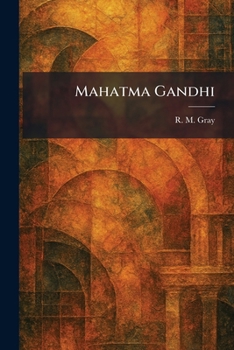
Mahatma Gandhi

"Mahatma Gandhi" by R. M. Gray offers a profound and contemporary exploration of the life and philosophy of one of the twentieth century's most influential figures. Written during a pivotal era in the Indian struggle for independence, this work examines the evolution of Mohandas Karamchand Gandhi from a young lawyer in South Africa to the spiritual and political leader of a nation.
The book delves into the core principles of Satyagraha (non-violent resistance) and Ahimsa (non-violence), illustrating how Gandhi applied these concepts to challenge the British Raj and inspire millions. Gray provides insightful analysis into Gandhi's ascetic lifestyle, his commitment to social reform, and his unique ability to bridge religious and cultural divides. By focusing on both the personal character and the public actions of the Mahatma, the author captures the essence of a movement that sought freedom through moral force rather than military might.
This study serves as an essential historical document for understanding the early twentieth-century geopolitical landscape and the spiritual foundation of modern India. Readers interested in political science, history, and the power of non-violent protest will find this work both enlightening and enduringly relevant.
This work has been selected by scholars as being culturally important, and is part of the knowledge base of civilization as we know it. This work was reproduced from the original artifact, and remains as true to the original work as possible. Therefore, you may see the original copyright references, library stamps (as most of these works have been housed in our most important libraries around the world), and other notations in the work.
This work is in the public domain in the United States of America, and possibly other nations. Within the United States, you may freely copy and distribute this work, as no entity (individual or corporate) has a copyright on the body of the work.
As a reproduction of a historical artifact, this work may contain missing or blurred pages, poor pictures, errant marks, etc. Scholars believe, and we concur, that this work is important enough to be preserved, reproduced, and made generally available to the public. We appreciate your support of the preservation process, and thank you for being an important part of keeping this knowledge alive and relevant.
Customer Reviews
ThriftBooks ® and the ThriftBooks ® logo are registered trademarks of Thrift Books Global, LLC
