


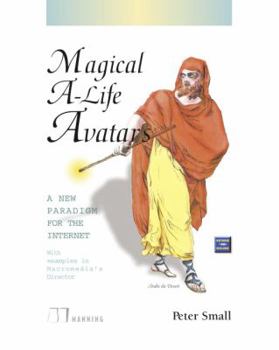
Magical A-Life Avatars: A New Paradigm for the Internet

Written for designers and programmers who feel limited by the conventional ways, here is an approach to the design products and services for the Internet and the World Wide Web. The book offers... This description may be from another edition of this product.
Format:Paperback
Language:English
ISBN:1884777589
ISBN13:9781884777585
Release Date:November 1998
Publisher:Manning Pubns Co
Length:418 Pages
Weight:1.68 lbs.
Dimensions:9.5" x 1.3" x 7.8"
Customer Reviews
2 ratings
Relevant to Knowledge Management and Web Marketing
Published by Thriftbooks.com User , 24 years ago
Some people may be put off by the author's referrences to magic and sorcery in his titles. In my opinion, Peter Small has something important to say to those of us interested in knowledge management and Web marketing. An avatar is an animated character on a computer screen and may represent a real person in a virtual world. In my opinion, the importance of avatars is not so much in the programming behind them (as impressive as that may be) but in the human willingness to attribute emotion and intelligence to avatars. An avatar that can access a variety of forms of multimedia, can learn from a variety of sources, and can visually represent emotion is of great potential consequence. Peter Small is a visionary and makes some pretty "radical" statements in his books. This is about the juncture of artificial intelligence, object-oriented programming, and animated interface design. That is potentially a very rich juncture. I wish there was a virtual community of people interested in the practical applications of Mr. Small's ideas.
An entirely new way of approaching the Internet
Published by Thriftbooks.com User , 27 years ago
This book has three subject matters which all run in parallel, informing and commenting on each other. These subjects are: * the relationship between biological entities and computer objects * the future of the internet * OOPs programming in DirectorThe book is very clearly and cleverly written. The Lingo scripting, for example, is discussed in the main text in terms of its underlying principles, and the actual scripts are shown in illustrations, reproducing Director's script window. This means that the underlying arguments can be read without interruption, and by readers who have no Lingo experience.Indeed many of the arguments in the book are addressed to a much wider audience than Director users and Lingo programmers. Peter Small suggests through a series of analogies and practical examples that there may be less difference between human and artificial intelligence than is normally thought - if we concentrate on the effects of intelligence rather than getting caught up in arguments as to what intelligence is and where it comes from.He uses a wide range of examples, introducing the idea of Hilbert Space as his final conceptual flourish. Against the odds he even manages to explain this abstruse mathematical concept clearly and simply, and then demonstrate convincingly how it can be a useful tool for thinking about the future development of multimedia.Peter's concern with multimedia lies in the development of 'intelligent' multimedia entities that he refers to as avatars - entities which can grow and change, accessing information on local hard disks, on CD-Roms and on the world wide web. The primary difference between these and traditional bots is that they are designed to operate from a client oriented perspective, rather than the more usual server side emphasis. They are designed to grow organically, to exceed the original intentions of the original programmers. They are designed to be diverse and different, and to use that as a strength.In many ways Peter is proposing a complete inversion of the way we currently see the Internet. It is usually seen as a new broadcasting medium - I have a website and you can tune into it. Peter suggests that this is a very limited and limiting way to see what is essentially a huge repository of information, all able to be communicated in any way we can imagine. He suggests that the idea of the standard, generalised browser is an idea whose time has more or less gone. Instead he proposes specialised avatar systems who can respond to their users needs and desires and extend themselves across the web to bring back information in useful and structured forms.One of his demonstrations concerns the construction of a café which can be used to bring like-minded people together, while another concerns avatar web-bots which can be sent off in search of like-minded people to bring to the café. Both of these are described in terms of the fundamental principles, their likely effects - a
Copyright © 2026 Thriftbooks.com Terms of Use
| Privacy Policy | Do Not
Sell/Share My Personal Information | Cookie Policy | Cookie Preferences | Accessibility Statement
ThriftBooks® and the ThriftBooks® logo are registered trademarks of Thrift Books Global, LLC
ThriftBooks® and the ThriftBooks® logo are registered trademarks of Thrift Books Global, LLC
