


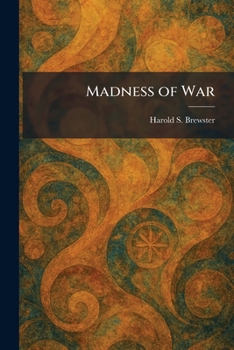
Madness of War

Select Format
Select Condition 
Book Overview
"Madness of War" is a compelling and thought-provoking exploration of the moral and psychological consequences of armed conflict. Written in the wake of the First World War, Harold S. Brewster presents a passionate argument against the cyclical nature of violence and the institutionalized glorification of battle. The work delves into the ethical contradictions inherent in modern warfare, questioning how civilized societies and religious institutions can reconcile the devastation of war with core human values.
Brewster examines the "madness" that grips nations during times of crisis, leading to a loss of reason and a departure from spiritual integrity. This volume serves as a significant contribution to pacifist literature, offering a critique of the economic and political forces that drive military engagement while advocating for a path rooted in conscience and non-violence. Its insights into the human condition and the destructive power of organized aggression remain profoundly relevant for readers interested in the history of peace movements, Christian social thought, and the philosophical underpinnings of international relations.
This work has been selected by scholars as being culturally important, and is part of the knowledge base of civilization as we know it. This work was reproduced from the original artifact, and remains as true to the original work as possible. Therefore, you may see the original copyright references, library stamps (as most of these works have been housed in our most important libraries around the world), and other notations in the work.
This work is in the public domain in the United States of America, and possibly other nations. Within the United States, you may freely copy and distribute this work, as no entity (individual or corporate) has a copyright on the body of the work.
As a reproduction of a historical artifact, this work may contain missing or blurred pages, poor pictures, errant marks, etc. Scholars believe, and we concur, that this work is important enough to be preserved, reproduced, and made generally available to the public. We appreciate your support of the preservation process, and thank you for being an important part of keeping this knowledge alive and relevant.
Customer Reviews
ThriftBooks ® and the ThriftBooks ® logo are registered trademarks of Thrift Books Global, LLC
