


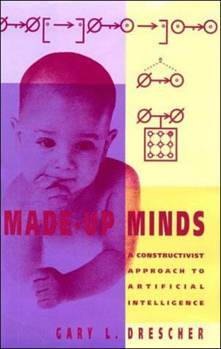
Made-Up Minds: A Constructivist Approach to Artificial Intelligence

Select Format
Select Condition 
Book Overview
Made-Up Minds addresses fundamental questions of learning and concept invention by means of an innovative computer program that is based on the cognitive-developmental theory of psychologist Jean Piaget. Drescher uses Piaget's theory as a source of inspiration for the design of an artificial cognitive system called the schema mechanism, and then uses the system to elaborate and test Piaget's theory. The approach is original enough that readers need not have extensive knowledge of artificial intelligence, and a chapter summarizing Piaget assists readers who lack a background in developmental psychology. The schema mechanism learns from its experiences, expressing discoveries in its existing representational vocabulary, and extending that vocabulary with new concepts. A novel empirical learning technique, marginal attribution, can find results of an action that are obscure because each occurs rarely in general, although reliably under certain conditions. Drescher shows that several early milestones in the Piagetian infant's invention of the concept of persistent object can be replicated by the schema mechanism.
Format:Paperback
Language:English
ISBN:0262517086
ISBN13:9780262517089
Release Date:January 2003
Publisher:MIT Press
Length:240 Pages
Weight:0.72 lbs.
Dimensions:0.5" x 6.0" x 9.0"
Age Range:18 years and up
Grade Range:Postsecondary and higher
Customer Reviews
1 rating
A significant advance in Artificial Intelligence
Published by Thriftbooks.com User , 25 years ago
This book describes a theory of how a computer program might be implemented to learn and use new concepts that have not been programmed into it. It uses the theories and observations of Jean Piaget, theories of learning in infants and children, as a basis on which to formulate a new vocabulary which allows us to talk in concrete terms about formerly vague and confusing concepts which are central to the understanding and engineering of intelligence. The central proposition of the theory is the "schema mechanism", which describes an elegant and technically and philosophically satisfying mechanism for how a learning system can incorporate new and previously incomprehensible fragments of knowledge, to build new and robust descriptions of objects and the effects of actions upon them. These new "schemas" can be incorporated into yet more complex descriptions of the environment, providing a robust and self-consistent system that can bootstrap itself to higher and higher levels of competence and intelligence, without need for any external intervention from the programmer except in the form of "teaching" the system as you would a real human infant.I believe this book represents the largest advance in artificial intelligence theory since Alan Turing described the first universal computer, and is comparable in importance to the inventions of Algebra and Calculus as notational systems and technologies which allowed progress in the fields of science and engineering.
Copyright © 2026 Thriftbooks.com
Terms of Use | Privacy Policy | Do Not Sell/Share My Personal Information | Cookie Policy | Cookie Preferences | Accessibility Statement
ThriftBooks ® and the ThriftBooks ® logo are registered trademarks of Thrift Books Global, LLC
ThriftBooks ® and the ThriftBooks ® logo are registered trademarks of Thrift Books Global, LLC
