


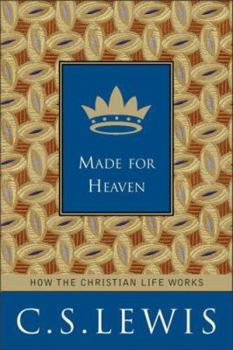
Made for Heaven: How the Christian Life Works

Select Format
Select Condition 
Book Overview
Why We Still Haven't Found What We're Looking For We long for heaven, and we will never feel fully at home until we get there. This keen insight into our souls pervades the writings of C. S. Lewis. From his Chronicles of Narnia to Mere Christianity , Lewis's writings continually return to the theme of heaven as our true home, the land we have been searching for our whole lives, a place where all is finally made right and that all the joys in this life point to. With selections from The Weight of Glory , The Great Divorce , and The Problem of Pain , this collection includes some of Lewis's most beautiful and profound writing on heaven, revealing how our destinies transform every aspect of our lives.
Format:Hardcover
Language:English
ISBN:0060766921
ISBN13:9780060766924
Release Date:February 2005
Publisher:HarperOne
Length:112 Pages
Weight:0.57 lbs.
Dimensions:6.3" x 0.5" x 4.3"
Age Range:16 years and up
Customer Reviews
2 ratings
Best Spiritual Insight, EVER !
Published by Curious Rhinoceros , 6 years ago
The essential insights of CS Lewis... and the clearest picture I’ve ever found of WHY it (God / Spirit / Soul) matters... and perhaps also of what’s most important to KNOW and to DO if it does!
Holy words
Published by Thriftbooks.com User , 20 years ago
C.S. Lewis was a rare individual. One of the few non-clerics to be recognised as a theologian by the Anglican church, he put forth the case for Christianity in general in ways that many Christians beyond the Anglican world can accept, and a clear description for non-Christians of what Christian faith and practice should be. Indeed, Lewis says in his introduction that this text (or indeed, hardly any other he produced) will help in deciding between Christian denominations. While he describes himself as a 'very ordinary layman' in the Church of England, he looks to the broader picture of Christianity, particularly for those who have little or no background. The discussion of division points rarely wins a convert, Lewis observed, and so he leaves the issues of ecclesiology and high theology differences to 'experts'. Lewis is of course selling himself short in this regard, but it helps to reinforce his point. This book derives from several of his works: 'The Great Divorce', 'The Problem of Pain', and 'Weight of Glory'. With regard to the Great Divorce, Lewis here derives the title in antithesis of William Blake, who wrote of the marriage of Heaven and Hell. He also is paying tribute to that kind of literature with a long pedigree (including such luminaries as Dante) who write of a visit to Heaven and Hell. In his narrative, Lewis introduces many characters who, the reader slowly discovers, are not in Heaven because they refuse to let go of something, even something rather miniscule, of the Hell in which they find themselves. 'If we accept Heaven we shall not be able to retain even the smallest and most intimate souvenirs of Hell,' Lewis states. However, upon letting go, one finds that nothing has in fact been lost. In 'The Problem of Pain', Lewis deals with the subject that confounds ministers, theologians and philosophers throughout the ages - why would a loving God not put an end to agony in the world? Why does an all-powerful God permit suffering? The excerpt here derives from Lewis' exposition beginning with Paul's epistle to the Romans - 'the sufferings of this present time are not worthy to be compared with the glory that shall be revealed in us.' Lewis looks generally at the problem as an interplay between self, desire, experience and God. This small excerpt does not answer the question definitively, but hopefully with inspire readers to go to the primary text. In the 'Weight of Glory', Lewis talks a lot about virtue and the style of living; we are called to live in such a way as to bring heaven as close as possible. 'Weight of Glory' is actually a sermon, which contains memorable passages that hearken back to the gospel message of seeing people as potential heavenly beings - as Jesus likened the visitation and good-deed-doing to 'the least of these' as doing so to him, so too does Lewis state that 'there are no ordinary people'; each person is a neighbour in God, and as such, a possessor of the same holiness as we are called to
Copyright © 2026 Thriftbooks.com Terms of Use
| Privacy Policy | Do Not
Sell/Share My Personal Information | Cookie Policy | Cookie Preferences | Accessibility Statement
ThriftBooks® and the ThriftBooks® logo are registered trademarks of Thrift Books Global, LLC
ThriftBooks® and the ThriftBooks® logo are registered trademarks of Thrift Books Global, LLC
