


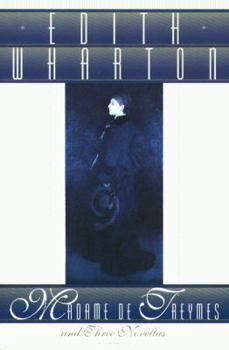
Madame de Treymes and Three Novellas


Select Format
Select Condition 
Book Overview
Madame de Treymes, Edith Wharton's first publication after the highly successful The House of Mirth, is a captivating portrait of turn-of-the-century American and French culture. Inspired by Wharton's own entr into Parisian society in 1906 and reminiscent of the works of Henry James, it tells the story of two young innocents abroad: Fanny Frisbee of New York, unhappily married to the dissolute Marquis de Malrive, and John Durham, her childhood friend who arrives in Paris intent on convincing Fanny to divorce her husband and marry him instead. A subtle investigation of the clash of cultures and the role of women in the social hierarchy, Madame de Treymes confirms Edith Wharton's position, as Edmund Wilson wrote, as "an historian of the American society of her time." This Scribner edition of Madame de Treymes also includes three novellas: The Touchstone, Sanctuary, and Bunner Sisters. These short works are rich in the social satire and cunning insight that characterized Wharton's highly acclaimed novels The Age of Innocence and The House of Mirth.
Format:Paperback
Language:English
ISBN:0684806843
ISBN13:9780684806846
Release Date:December 1995
Publisher:Scribner Book Company
Length:400 Pages
Weight:0.90 lbs.
Dimensions:0.9" x 5.3" x 8.0"
Related Subjects
Classics Contemporary Criticism & Theory Fiction History & Criticism Literary Literature & FictionCustomer Reviews
1 rating
Short stuff
Published by Thriftbooks.com User , 18 years ago
In a way, Edith Wharton was at her best in her novellas -- her stories are lean, taut and emotionally deep. And the rather elusive "Madame De Treymes and Three Novellas" brings together four of her not-so-well-known novellas, elongated short stories that explore love, morality, betrayal, the conventions on both sides of the Atlantic, and povert. They're not just fascinating, but beautifully written. "The Touchstone" was Wharton's first novella that made it to print. Stephen Glennard needs money to marry his fiancee, but his job is in tatters. So he decides to sell the love letters left to him by his ex-girlfriend, a famous and newly deceased author -- to live happily ever after with one lover, Glennard will betray another. "Madame De Treymes" is a sort of Henry Jamesian novella, taking place in early twentieth-century Paris. It follows the unhappy lives abroad of two Americans -- the miserable Fanny Frisbee is married to a nasty aristocrat, and living in Paris. As a knight on a white horse, her friend John is trying to convince her to divorce her hubby and marry him. Of course, it can't be THAT simple. "The Bunner Sisters" is one of Wharton's darkest stories, in which two timid sisters run a small, failing shop together. When Ann Eliza gives Evalina a gifts, they both become involved with the mysterious man, Ramy, who sold it to her. Ann Eliza attempts to sacrifice money and happiness for her sister's happiness, but neither knows what Ramy is hiding from them, or how it will destroy their lives. And in "Sanctuary," Kate Orme is horrified when she discovers a blinkered moral failing in her fiancee, which led to a woman's death. Determined to save his kids from a similar flaw, she marries him and is pretty quickly widowed. But years later, her brilliant, charming young son is given a tempting offer that may lead him to cheat his way through a contest. Edith Wharton was all about unvarnished looks at society, whether it was the society of New York slums, the Manhattan wealthy, or a French aristocratic family. And while these novellas aren't her best, or most insightful, they pack a certain dramatic punch, no matter what happens to her characters. She usually had a formal, often poetic writing style, rich with light, smells, sounds and the swirl of nature. Two of these stories qualify, but two are less so -- "Bunner Sisters" is painfully grimy and bleak, and "Sanctuary" has the feeling of a full-length novel that Wharton never got around to fully fleshing out. But whatever the prose was like, it was overshadowed by the bones of her stories -- if she took a hard look at hypocrises and social conventions, she didn't flinch from showing what happened to those that transgressed. Some become wealthy, some fade into homeless poverty. It's realistic, but a bit depressing. The main characters are not quite as realistic in some of these as in some of her works -- Kate Orme is a big bundle of whiny manic angst, and Evalina is just too limp. But most o
Copyright © 2026 Thriftbooks.com
Terms of Use | Privacy Policy | Do Not Sell/Share My Personal Information | Cookie Policy | Cookie Preferences | Accessibility Statement
ThriftBooks ® and the ThriftBooks ® logo are registered trademarks of Thrift Books Global, LLC
ThriftBooks ® and the ThriftBooks ® logo are registered trademarks of Thrift Books Global, LLC
