


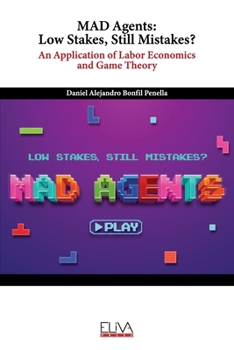
MAD Agents: Low Stakes, Still Mistakes?: An Application of Labor Economics and Game Theory
No Customer Reviews

Agents in numerous jobs and sectors are paid on a performancecontingent basis. There exists an increasing global demand for an online workforce whose pay, or part of it, will also be based on performance. Several papers have shown that performance-contingent payments improve quality and effort compared to non-contingent compensation systems. To the contrary, experimental evidence from Ariely et al (2009) show that workers' performance does not improve despite relatively large magnitude rewards; and that the large magnitude has a detrimental effect on performance caused by overreaction or "choking." Performance may also be hampered by low magnitude rewards since it damages intrinsic motivation as shown by Gneezy & Rustichini (2000). In addition, Yin et al (2013) show that absolute magnitude of rewards alone does not affect agent's performance, but changing the magnitude over a sequence of tasks does. Ho et al (2015) identify effort-responsive tasks and the extent of appropriateness of performance-contingent financial incentives (PCFI). To test the impact of PCFI, we design a large-scale field experiment using the online labor market Amazon Mechanical Turk (MTurk) to evaluate agents' response to monetary incentives over a sequence of three cognitive games: NBack, Stroop and Iowa. Our findings suggest that small magnitude incentives can alleviate the choking effect, improving performance by 3.5% (*p
Format:Paperback
Language:English
ISBN13:9781636480220
Release Date:November 2020
Publisher:Eliva Press
Length:118 Pages
Weight:0.51 lbs.
Dimensions:9.0" x 0.3" x 6.0"
Customer Reviews
0 rating
Copyright © 2026 Thriftbooks.com
Terms of Use | Privacy Policy | Do Not Sell/Share My Personal Information | Cookie Notice | Cookie Preferences | Accessibility Statement
ThriftBooks ® and the ThriftBooks ® logo are registered trademarks of Thrift Books Global, LLC
ThriftBooks ® and the ThriftBooks ® logo are registered trademarks of Thrift Books Global, LLC
