


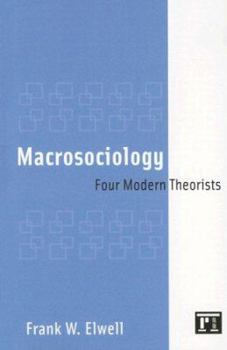
Macrosociology: Four Modern Theorists

Select Format
Select Condition 
Book Overview
Social theorists dwell on the canonical works of Marx, Weber, and Durkheim but little on the theories of the major contemporary macrotheorists. This book fills this gap with a focus on the work of four modern theorists who have taken on the larger questions spawned by classical social theory. C. Wright Mills, Marvin Harris, Immanuel Wallerstein, and Gerhard Lenski have examined such phenomena and processes as the rise and impact of capitalism; the centralization and enlargement of authority; inequality; and the historical intensification of production and populations. Borrowing what is useful from the classics as well as relying on contemporary practitioners and empirical evidence, each theorist adds his own insights and interpretations in constructing a comprehensive perspective of sociocultural stability and change. This book fully synthesizes and documents each perspective, using language and examples that resonate with the general reader. A short biography on each theorist is also provided.
Format:Paperback
Language:English
ISBN:1594512582
ISBN13:9781594512582
Release Date:June 2006
Publisher:Routledge
Length:192 Pages
Weight:0.55 lbs.
Dimensions:0.6" x 5.6" x 8.6"
Customer Reviews
2 ratings
Classical social theory is alive!
Published by Thriftbooks.com User , 19 years ago
Here is a work that covers four modern practioners of classical sociological analysis. Elwell explains his reasoning for analyzing the work of C. Wright Mills, Marvin Harris, Gerhard Lenski, and Immanuel Wallerstein, "By focusing on four recent practioners I hope to interest a new generation of sociology students in the excitement and rewards of holistic analyses." Elwell laments the all too common practice of teaching sociological theory "as history". Instead, Elwell believes theory frames our understanding of history and society so that we can all better understand the 'world around us.' Elwell contributes to this undertaking by analyzing Mills, Lenski, Wallerstein, and Harris in a book that is accessible to both undergraduates and lay readers. Fortunately, Elwell's book is free from the sociological catch-phrases that characterize the work of myopic careerists and obscurantists. Social theory is valuable to the extent that it helps render social processes visible and understandable. Each of the theorists covered borrowed heavily from the classical tradition of sociology (Marx, Weber, Durkheim, and Veblen) and each analyzed society as a system. The chapter on C. Wright Mills is the best summary of the mans work I know of and written with eminently readable prose-- documenting Mill's analyses of the Power Elites, Mass Society, rationalization, and the role of social science. Harris and Lenski both emphasize the impact of technology on production, work patterns, and inequality and contribute to the building of a research strategy of understanding past and contemporary societies alike. Chapter 3 covers the work of the originator of world-systems analysis, Immanuel Wallerstein. Wallerstein is definitely one of the most original and controversial sociologists today. Wallerstein has dedicated his life to understanding what he calls `the capitalist world-system' and has pronounced that the world is currently experiencing the breakdown of the capitalist system. Elwell's book is indispensable reading for anyone interested in the rewarding task of understanding society through classical sociological analysis.
important sociology for undergrads and non-sociologists
Published by Thriftbooks.com User , 19 years ago
I'm a historian, not a sociologist, and to be honest, I have found the work of some sociologists to be incomprehensible, jargon-laden stuff. That is most assuredly not the case here. Frank W. Elwell writes well, in a manner that should be comprehensible (if not easy--but then macrosociological theory isn't easy) for undergraduates, and was very interesting indeed for me. The four theorists are Marvin Harris (cultural materialism), Immanuel Wallerstein ("World-Systems Analysis"), Gerhard Lenski ("Ecological-Evolutionary Theory"), and the perhaps best known, at least to the general reader, C. Wright Mills (bureaucracy, elites, and all that good stuff). I do historiography (the study of historians and their interpretations of history), and I find that introducing students to an individual historian works better than introducing them to a topic. So just one of the things I like about this book is that Elwell focuses on individual thinkers rather than broad themes (though the themes emerge). There are even little boxed-off sections on the life of each of the theorists. The back cover is correct in its assertion that Elwell uses "language and examples that resonate with the general reader." I strongly recommend this book.
Copyright © 2026 Thriftbooks.com Terms of Use
| Privacy Policy | Do Not
Sell/Share My Personal Information | Cookie Policy | Cookie Preferences | Accessibility Statement
ThriftBooks® and the ThriftBooks® logo are registered trademarks of Thrift Books Global, LLC
ThriftBooks® and the ThriftBooks® logo are registered trademarks of Thrift Books Global, LLC
