


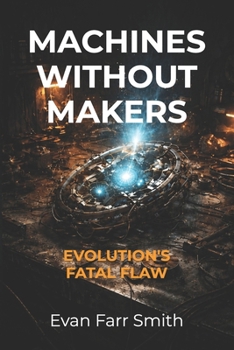
Machines Without Makers: Evolution's Fatal Flaw

What if the most accepted explanation for life is missing its foundation?
Evolution explains how life changes.
It does not explain how life begins.
Before natural selection can act, something must already exist:
A system capable of replicationInformation stored and transmittedCoordinated function across many partsWithout these, evolution has nothing to work on.
Despite decades of research, no experiment has demonstrated how nonliving matter becomes a functioning, self-replicating system. Chemistry can produce components. But components are not systems. Parts do not become life simply with time.
Machines Without Makers examines this gap directly.
Drawing on scientific literature and observable principles, this book separates what has been demonstrated from what has been assumed:
The difference between adaptation and originWhy time does not create coordinated complexityThe role of information in living systemsThe limits of undirected processesThis is not an argument against science.
It is an argument for completeness.
If life requires information, coordination, and structure, then any explanation must account for their origin-not assume them.
The question is not whether life changes.
The question is whether life can begin without intelligence.
Customer Reviews
ThriftBooks ® and the ThriftBooks ® logo are registered trademarks of Thrift Books Global, LLC
