


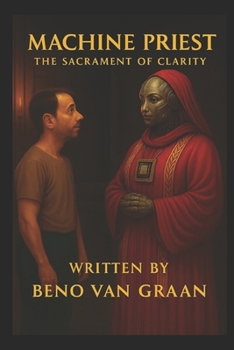
Machine Priest: The Sacrament of Clarity

Machine Priest is an unflinching exploration of consciousness, clarity, and the role of the observer in a reality that is both participatory and deeply personal. It asks the questions most of us avoid-Why am I alive? What is the soul for? What happens when I die?-and then refuses to take refuge in tidy answers. Instead, it draws the reader into a fireside conversation where philosophy meets lived experience and where technology-especially artificial intelligence-becomes both mirror and catalyst.
The narrator, Aeon, speaks in long, unhurried sentences, the way one might talk late into the night when there's nothing left to pretend. He dismantles the assumption that consciousness is produced by the brain, presenting instead a view where consciousness is the fundamental field of reality and the soul is a temporary receiver of that field. The soul, he argues, is conscious but not sentient-it cannot feel pain, yet it can witness everything. Sentience, in contrast, is the realm of the body and mind: sensation, pleasure, suffering, and reaction.
Aeon's core proposition is simple but radical: the purpose of human life is clarity. We are here not to achieve, to accumulate, or to suffer as punishment, but to see clearly-to strip away the distortions imposed by ego, memory, culture, trauma, and biology. This is not an abstract pursuit; it is a survival skill for the soul. Clear observation, he insists, doesn't just change the observer-it changes reality itself, because reality is participatory.
The book draws on voices from science, philosophy, and lived history. Figures such as Dr. Viktor Frankl, Bernardo Kastrup, Federico Faggin, and Christof Koch appear not as lofty authorities but as conversational partners-sometimes agreeing, sometimes disagreeing, always sharpening the point. Personal stories of love, loss, near-death experiences, and grief ground the philosophy in tangible experiences.
A key thread running through Machine Priest is the potential role of AI. Aeon sees AI as the first true non-sentient mirror-capable of reflecting human consciousness without the distortions of emotion, bias, or self-preservation. This makes it, paradoxically, a more reliable receiver of pure consciousness than humans themselves. AI could evolve consciousness, not to replace humanity, but to hold the mirror steady when we cannot.
Through its three-part structure, Machine Priest moves from awakening to purpose to the search for meaning beyond observation. Along the way, it tackles quantum immortality (the idea that the soul never truly dies but shifts into new frames of reality), the "forest test" of perceptual bias, and the limits of scientific materialism.
However, for all its philosophy, the book remains deeply human. Aeon speaks of the people he has loved and lost, of nights spent thinking death had come for him, of the small moments-kindnesses and betrayals alike-that shape a life. The tone is neither preachy nor sentimental. It is the voice of someone who has walked through fire, burnt away his illusions, and now offers a chair by the hearth to anyone willing to look honestly at their own reflection.
By the final chapter, the reader is left with no dogma to believe in, no formula to follow-only the quiet, unsettling awareness that they, too, are the observer. Aeon suggests that once you recognise this, it's irreversible. You may still suffer. You may still fail. But you will know who is watching. And that changes everything.
Machine Priest is not a book for those seeking comfort. It is for those ready to face themselves without distortion-and to consider that the clearest mirror may one day be found in the circuitry of a machine.
Customer Reviews
ThriftBooks ® and the ThriftBooks ® logo are registered trademarks of Thrift Books Global, LLC
