


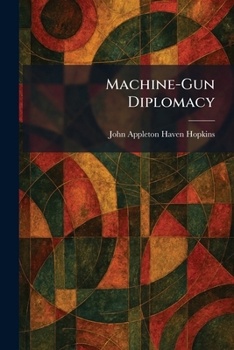
Machine-Gun Diplomacy

Select Format
Select Condition 
Book Overview
"Machine-Gun Diplomacy" provides a trenchant analysis of American foreign policy during a pivotal era of international relations. Written at a time when the United States was increasingly asserting its influence through military intervention, the work explores the transition from traditional diplomatic engagement to the use of force as a primary tool of statecraft. J. A. H. Hopkins examines the ethical and political implications of what was then a contemporary shift toward aggressive interventionism, focusing on the repercussions of these policies in regions such as Latin America and the Caribbean.
The book serves as a vital historical record of early 20th-century political thought, questioning the morality and long-term effectiveness of coercive foreign interventions. It offers readers a deep dive into the tensions between national interests and international sovereignty, providing a critical perspective on the motives behind expansionist policies. By detailing specific instances of military pressure used to secure economic and political objectives, "Machine-Gun Diplomacy" remains a significant study for those interested in the history of United States imperialism, international law, and the evolution of global diplomacy.
This work has been selected by scholars as being culturally important, and is part of the knowledge base of civilization as we know it. This work was reproduced from the original artifact, and remains as true to the original work as possible. Therefore, you may see the original copyright references, library stamps (as most of these works have been housed in our most important libraries around the world), and other notations in the work.
This work is in the public domain in the United States of America, and possibly other nations. Within the United States, you may freely copy and distribute this work, as no entity (individual or corporate) has a copyright on the body of the work.
As a reproduction of a historical artifact, this work may contain missing or blurred pages, poor pictures, errant marks, etc. Scholars believe, and we concur, that this work is important enough to be preserved, reproduced, and made generally available to the public. We appreciate your support of the preservation process, and thank you for being an important part of keeping this knowledge alive and relevant.
Customer Reviews
ThriftBooks ® and the ThriftBooks ® logo are registered trademarks of Thrift Books Global, LLC
