


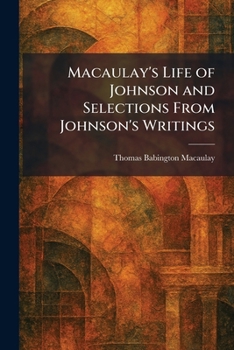
Macaulay's Life of Johnson and Selections From Johnson's Writings

"Macaulay's Life of Johnson and Selections From Johnson's Writings" offers a profound look at one of the most influential figures in English literary history through the lens of another master of prose, Thomas Babington Macaulay. This volume features Macaulay's celebrated biographical essay on Samuel Johnson, providing a vivid and psychologically acute portrait of the man who defined an era of letters. Macaulay tracks Johnson's trajectory from his early hardships and physical ailments to his rise as the preeminent lexicographer, essayist, and moralist of 18th-century London.
Complementing Macaulay's narrative is a thoughtful selection of Johnson's own writings, allowing readers to engage directly with his formidable intellect and distinctive style. These excerpts highlight the range of Johnson's genius, from his critical insights to his moral philosophy. By combining 19th-century biographical analysis with primary texts, this work serves as an essential resource for students of English literature and history alike. It captures not only the life of the man behind the first great English dictionary but also the enduring legacy of his contributions to the Western canon.
This work has been selected by scholars as being culturally important, and is part of the knowledge base of civilization as we know it. This work was reproduced from the original artifact, and remains as true to the original work as possible. Therefore, you may see the original copyright references, library stamps (as most of these works have been housed in our most important libraries around the world), and other notations in the work.
This work is in the public domain in the United States of America, and possibly other nations. Within the United States, you may freely copy and distribute this work, as no entity (individual or corporate) has a copyright on the body of the work.
As a reproduction of a historical artifact, this work may contain missing or blurred pages, poor pictures, errant marks, etc. Scholars believe, and we concur, that this work is important enough to be preserved, reproduced, and made generally available to the public. We appreciate your support of the preservation process, and thank you for being an important part of keeping this knowledge alive and relevant.
Customer Reviews
ThriftBooks ® and the ThriftBooks ® logo are registered trademarks of Thrift Books Global, LLC
