


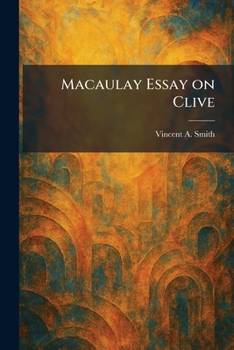
Macaulay Essay on Clive

Select Format
Select Condition 
Book Overview
"Macaulay Essay on Clive" provides a profound and enduring analysis of the life and legacy of Robert Clive, the foundational figure of British rule in India. Written by the celebrated historian and prose stylist Thomas Babington Macaulay, this work chronicles Clive's remarkable transformation from a restless East India Company clerk to the victorious military leader at the Battle of Plassey. The narrative offers a detailed exploration of the political maneuvers, military strategies, and moral dilemmas that shaped the 18th-century Indian subcontinent during the collapse of the Mughal Empire and the rise of British hegemony.
This edition, edited and annotated by the respected historian Vincent A. Smith, adds significant scholarly value by providing historical context and critical analysis that illuminates the complexities of colonial expansion. Macaulay's vivid writing brings to life the landscapes and power dynamics of the era, while Smith's expertise ensures that the historical figures and events are understood within their broader global significance. "Macaulay Essay on Clive" remains an essential work for those interested in the history of the British Raj, the ethics of empire, and the biographical study of one of history's most influential yet controversial figures. It is both a literary masterpiece and a vital historical record.
This work has been selected by scholars as being culturally important, and is part of the knowledge base of civilization as we know it. This work was reproduced from the original artifact, and remains as true to the original work as possible. Therefore, you may see the original copyright references, library stamps (as most of these works have been housed in our most important libraries around the world), and other notations in the work.
This work is in the public domain in the United States of America, and possibly other nations. Within the United States, you may freely copy and distribute this work, as no entity (individual or corporate) has a copyright on the body of the work.
As a reproduction of a historical artifact, this work may contain missing or blurred pages, poor pictures, errant marks, etc. Scholars believe, and we concur, that this work is important enough to be preserved, reproduced, and made generally available to the public. We appreciate your support of the preservation process, and thank you for being an important part of keeping this knowledge alive and relevant.
Customer Reviews
ThriftBooks ® and the ThriftBooks ® logo are registered trademarks of Thrift Books Global, LLC
