


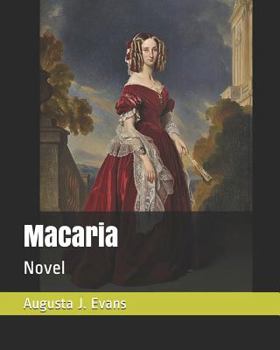
Macaria: Novel


Select Format
Select Condition 
Book Overview
First published in 1864, Macaria; or, Altars of Sacrifice was the third novel of Augusta Jane Evans, one of the leading women writers of nineteenth-century domestic fiction. A wartime best seller, with more than twenty thousand copies in circulation in the print-starved Confederacy before the war's end, the novel was also extremely well received along the Union front, so much so that some northern officials thought it should be banned. Long out of print and largely unavailable until now, Macaria is a compelling narrative about women and war. In Macaria, Evans charts the journey of two southern women toward ultimate self-realization through their service in the war-torn Confederacy. Irene and Electra struggle to assert their independence and gain for themselves a place in southern society apart from their now-disrupted domestic roles. Discarding the traditional theme of romantic fulfillment, Evans skillfully crafts a novel about women compelled by the departure and death of so many southern men to find meaning in their own "single blessedness, " rather than in marriage. Thus Evans successfully subverts the characteristic form of women's fiction, that of the romance narrative, to create a "quest" narrative, more common in men's fiction. Macaria appealed directly and calculatedly to sentiments prevailing within its potential audience of southern women readers - acknowledging their fears of uselessness and of widowhood or spinsterhood, as well as their attraction to a new language of self-determination. In her perceptive introduction to this edition, Drew Gilpin Faust places the novel in the context of the concerns of Confederate nationalism and the contributions of women during the CivilWar. She shows that Evans, though a staunch supporter of the Confederacy and a wartime hospital volunteer, felt marginal to the war effort and, like many other women, bemoaned this fact in diaries and letters. It is from this aspect, the emergence of the literary woman, that Faust ...Augusta Jane Evans, or Augusta Evans Wilson (May 8, 1835 - May 9, 1909), was an American author of Southern literature. She was the first woman to earn US$100,000 through her writing.Wilson was a native of Columbus, Georgia, and her first book, Inez, a Tale of the Alamo, was written when she was still young. It was published by Harpers, but met with indifferent success. Her second book, Beulah, was issued in 1859 and became at once popular, still selling well when the American Civil War broke out. Cut off from the world of publishers, and intensely concerned for the cause of secession, she wrote nothing more until several years later when she published her third story, Macaria, dedicated to the soldiers of the Southern Army. This book was burned by some protesters. After the war closed, Wilson travelled to New York with the copy of St. Elmo, which was speedily published and met with great success. Her later works, Vashti; Infelice; and At the Mercy of Tiberius had phenomenal success. In 1868, she married Lorenzo Madison Wilson, of Alabama, and they resided at Spring Hill.
Format:Paperback
Language:English
ISBN:1790736234
ISBN13:9781790736232
Release Date:December 2018
Publisher:Independently Published
Length:154 Pages
Weight:0.70 lbs.
Dimensions:0.3" x 8.0" x 10.0"
Related Subjects
Fiction History Literary Literary Criticism & Collections Literature Literature & FictionCustomer Reviews
1 rating
Valueable Example of Confederate Propaganda
Published by Thriftbooks.com User , 26 years ago
When I discovered Drew Gilpin Faust's edition of Augusta evans's novel, _Macaria; or Altars of Sacrifice_ while working on a college research paper, I was excited to find an example of the writing of a woman I had read brief mentions of in various books and an example of fiction published in the South during the Civil War. Although Evans's writing is flawed, as was pointed out even during her lifetime, when writing was often more flowery, by occasional digressions to show off Evans's learning--as when one of the duel heroines has been observing the stars through her telescope and muses on astronomical history--Evans's story is compelling and valueable. The story concerns two heroines living in Mobile, where Evans lived by this time: Irene Huntingdon, who has been raised in luxury but seeks to be strong and to find meaning in her life instead of simply spending her time and her father's wealth on fashion and shallow socializing, and Irene's poorer, artistic friend, Electra Grey, with whom Irene remains friends despite both a longstanding grudge that Irene's father holds against Electra's family and Irene and Electra's enduring love for the same man. Faust explains in the introduction that a Union general banned his soldiers' reading of _Macaria_, which had been republished by her antebellum New York publisher soon after its publication; while Evans's southern characters often showed too much materialism, snobbery, and insensitivity to make the South seem like an unquestionably superior region, her refusal to write as if she accepted the by then explicit northern view of slavery as a centrally important issue in the war and her portrayal of her central characters' personal growth do give strong signs of why the general who banned it might have worried that it would weaken some people's commitment to restore the union and to accept the view of the war, promoted by the time of its publication, as a fight against slavery. A final reason for _Macaria_'s value is its resolution of the question of women's role in the South, regardless of class, at least as viewed in the emergency period of the civil War; _Macaria_ does not end with the usual conventions of nineteenth-century domestic novels, and Faust's introduction provides some mixed contemporary southern reactions to the way in which Evans chose to end her heroines' story.
Copyright © 2026 Thriftbooks.com
Terms of Use | Privacy Policy | Do Not Sell/Share My Personal Information | Cookie Notice | Cookie Preferences | Accessibility Statement
ThriftBooks ® and the ThriftBooks ® logo are registered trademarks of Thrift Books Global, LLC
ThriftBooks ® and the ThriftBooks ® logo are registered trademarks of Thrift Books Global, LLC
