


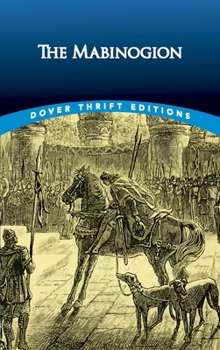
The Mabinogion


Select Format
Select Condition 
Book Overview
Composed in a golden age of Celtic storytelling in the thirteenth century or earlier, this collection of 12 Welsh prose tales is a masterpiece of European literature. Though written down in the Middle Ages, these stories are thought by scholars to be probably much older, perhaps going back to the dawn of Celtic civilization. They fall naturally into several groups: the Mabinogion (stories) proper, composed of the four tales of Pwyll, Branwen, Manawyddan, and Math; the two short pieces The Dream of Maxen Wledig and Lludd and Llevelys ; the incomparable Kilhwch and Olwen , one of the earliest Arthurian tales in Welsh; The Dream of Rhonabwy , a romantic look back to the heroic age of Britain; and the three Arthurian romances proper: The Lady of the Fountain , Peredur the Son of Evrawc , and Geraint the Son of Erbin , with their abundant evidence of Norman-French influences. Also included is Lady Guest's translation of Taliesin , the story of the famous bard. Destiny, magic, chance, knightly feats of arms, love, and betrayal -- all are here in these ancient, beautifully crafted stories, sure to delight scholars, students, general readers, and any lover of myth and legend.
Format:Paperback
Language:English
ISBN:0486295419
ISBN13:9780486295411
Release Date:April 1997
Publisher:Dover Publications
Length:224 Pages
Weight:0.81 lbs.
Dimensions:0.6" x 5.2" x 8.3"
Age Range:14 years and up
Grade Range:Grade 9 and higher
Customer Reviews
3 ratings
Ian Myles Slater on: Beautiful and Puzzling Tales
Published by Thriftbooks.com User , 20 years ago
The publishing history of this edition, and its relationship to other translations of what is commonly known as "The Mabinogion," is a little complicated, and I think that is worth clearing up, although it may be a little tedious. However, my explanation of it should serve as "buyer's guide" if you are hesitating over exactly what to order. In 1948 the Golden Cockerel Press issued an "edition-de-luxe" of translations from Medieval Welsh prose tales, made by Gwyn Jones and Thomas Jones, under the title of "The Mabinogion." This was the direct ancestor of the present Everyman volume. The translators, besides sharing a common Welsh name, were both distinguished academics: Thomas Jones was Professor of Welsh at Aberystwyth, and Gwyn Jones was Professor of English at Aberystwyth and Cardiff. This title of the book was, as the translators pointed out, an erroneous form, a mere scribal error turned into a comprehensive title for stories with quite diverse histories. It was established in the public mind in the nineteenth century by Lady Charlotte Guest, who issued the first complete English translation of the stories, with Welsh texts, published in seven volumes, 1838-1845. The English text and notes of the shorter 1848 edition of her version had been included in the "Everyman's Library" series since 1906. This fat (432 pages) little volume furthered its position with the literary public interested in Welsh matters, general Celtic literature, or Arthurian stories, despite enormous advances in Welsh studies in the intervening century before the Jones and Jones translation. (I have separately reviewed some of its recent editions, with more on the translator's remarkable life.) A more accurate translation by T.P. Ellis and J. Lloyd, "The Mabinogion: A New Translation," had been published by Oxford University Press in 1929, and seems to have made little impact. (One wonders: did the Depression play a role?) It had some useful annotations, and I have often wondered why it has never been reprinted, while Guest has gone into a variety of fuller or shorter versions (including the stories-only Dover Thrift edition, and one, apparently with the notes, illustrated by Alan Lee) of her bowdlerized and otherwise truncated rendering. Ellis and Lloyd continued to use Guest's title, and omitted one story, "Taliesin," a practice which Jones and Jones followed with no clear explanation. (I will offer one below.) Otherwise, the narrative contents of all three of these translations are the same. They contain stories in four categories. (Note that preferred spellings of proper names vary, and I have not tried to be fully consistent.) First, "The Four Branches of the Mabinogi," from which the collective title was derived, consisting of "Pwyll, Prince of Dyved," Branwen Daughter of Llyr," "Manawydan Son of Llyr," and "Math Son of Mathonwy." These begin with a story about the conception and birth of Pwyll's son, Pryderi, whose death is one of the early events in the "Fourt
An Excellent Account of Welsh Celtic Mythology
Published by Thriftbooks.com User , 26 years ago
The Mabinogion is an excellent collection of Welsh Celtic myths/legends. Certain tales are difficult to follow because of a large cast of characters and long list of events/deeds. Nevertheless, the Mabinogion portrays Celtic (Welsh) mythology well. There is an excellent summary of each tale, a guide to pronunciation of names and a map of the region. Together with the tales, these additions make this book exciting and easily accessible.
Excellent translation of an under-read classic
Published by Thriftbooks.com User , 27 years ago
Jeffrey Gantz's translation of The Mabinogion is not only the most readable to the modern man, unlike Guest, he doesn't delete passages thought "indelicate" by Victorian society. This is the best representation of these Welsh classics, and includes Gantz's own study of the mythology of these texts, a book in it's own right, as a prologue and at the beginning of each tale. A must for every library.
Copyright © 2025 Thriftbooks.com
Terms of Use | Privacy Policy | Do Not Sell/Share My Personal Information | Cookie Policy | Cookie Preferences | Accessibility Statement
ThriftBooks ® and the ThriftBooks ® logo are registered trademarks of Thrift Books Global, LLC
ThriftBooks ® and the ThriftBooks ® logo are registered trademarks of Thrift Books Global, LLC
