


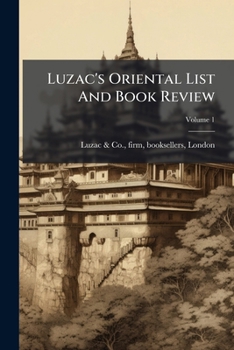
Luzac's Oriental List And Book Review; Volume 1

Luzac's Oriental List And Book Review, Volume 1 offers a fascinating glimpse into the world of Orientalist scholarship and the book trade at the turn of the 20th century. Published by Luzac & Co., a renowned London bookselling firm specializing in Oriental literature and languages, this volume provides a comprehensive listing of newly published books, along with insightful reviews. It serves as an invaluable resource for scholars, researchers, and collectors interested in Asian studies, linguistics, and comparative literature.
This meticulously compiled list showcases the breadth and depth of knowledge pertaining to the Orient, encompassing subjects ranging from history and religion to art and culture. The book reviews offer critical assessments of these publications, shedding light on their scholarly contributions and their significance within the field. As a historical document, "Luzac's Oriental List And Book Review" provides a unique perspective on the intellectual currents shaping Orientalist discourse and the global exchange of knowledge.
This work has been selected by scholars as being culturally important, and is part of the knowledge base of civilization as we know it. This work was reproduced from the original artifact, and remains as true to the original work as possible. Therefore, you will see the original copyright references, library stamps (as most of these works have been housed in our most important libraries around the world), and other notations in the work.
This work is in the public domain in the United States of America, and possibly other nations. Within the United States, you may freely copy and distribute this work, as no entity (individual or corporate) has a copyright on the body of the work.
As a reproduction of a historical artifact, this work may contain missing or blurred pages, poor pictures, errant marks, etc. Scholars believe, and we concur, that this work is important enough to be preserved, reproduced, and made generally available to the public. We appreciate your support of the preservation process, and thank you for being an important part of keeping this knowledge alive and relevant.
Customer Reviews
ThriftBooks® and the ThriftBooks® logo are registered trademarks of Thrift Books Global, LLC
