


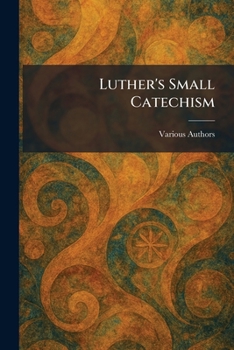
Luther's Small Catechism

"Luther's Small Catechism" is a foundational text of the Lutheran faith, designed to provide a clear and concise summary of Christian teachings for families and students. Written by Martin Luther, this work serves as a practical guide to the essentials of the Christian life, covering the Ten Commandments, the Apostles' Creed, the Lord's Prayer, and the sacraments of Holy Baptism, Confession, and the Sacrament of the Altar.
Through a series of simple questions and answers, the text explains the core theological principles of the Reformation, emphasizing grace, faith, and the authority of Scripture in a way that is accessible for daily devotions and instructional use. Its enduring value lies in its ability to translate complex theological concepts into plain language that can be easily understood by the laity. As a cornerstone of Protestant literature, "Luther's Small Catechism" remains an indispensable resource for understanding the foundations of Christian doctrine and the development of the Lutheran tradition. This work continues to be a vital tool for religious education, offering a structured and historically significant approach to spiritual growth and the understanding of biblical truths.
This work has been selected by scholars as being culturally important, and is part of the knowledge base of civilization as we know it. This work was reproduced from the original artifact, and remains as true to the original work as possible. Therefore, you may see the original copyright references, library stamps (as most of these works have been housed in our most important libraries around the world), and other notations in the work.
This work is in the public domain in the United States of America, and possibly other nations. Within the United States, you may freely copy and distribute this work, as no entity (individual or corporate) has a copyright on the body of the work.
As a reproduction of a historical artifact, this work may contain missing or blurred pages, poor pictures, errant marks, etc. Scholars believe, and we concur, that this work is important enough to be preserved, reproduced, and made generally available to the public. We appreciate your support of the preservation process, and thank you for being an important part of keeping this knowledge alive and relevant.
Customer Reviews
ThriftBooks ® and the ThriftBooks ® logo are registered trademarks of Thrift Books Global, LLC
