


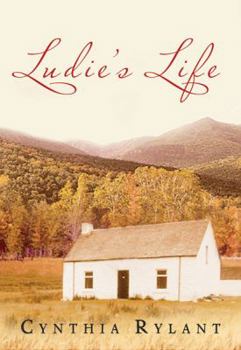
Ludie's Life


Select Format
Select Condition 
Book Overview
Cynthia Rylant returns to her home state of West Virginia with this powerful and evocative collection of poems. In a heartbreaking narrative that flows like a novel, we follow Ludie from childhood to falling in love and getting married, through the birth of her own children, and on into old age. This is the story of one woman's experiences in a hardscrabble coal-mining town, a story that brims with universal themes about life, love, and family--and all of the joy, laughter, heartache, and loss that accompany them. Would she tell you that six children were too many, that some disappointed, that others surprised, but that, all in all, six were too many and one would have been just fine. Would she tell you that she married that boy at fifteen not only because he was tall and kind but also because she needed a way out. -- from LUDIE'S LIFE
Format:Hardcover
Language:English
ISBN:0152053891
ISBN13:9780152053895
Release Date:November 2006
Publisher:Clarion Books
Length:116 Pages
Weight:0.54 lbs.
Dimensions:7.3" x 0.6" x 5.0"
Age Range:14 years and up
Grade Range:Grades 9 to 12
Customer Reviews
5 ratings
Ludie's Life
Published by Thriftbooks.com User , 18 years ago
Cynthia Rylant is a mostly children's book author, but she also writes some young adult novels. Their short and written in poems- similar to Sonya Sones, except the content of the books are extremely different. This book is about Ludie, obviously, and it just takes us through her life. Things that are important to her, things that happen, and just what she believes in. It's kind of hard to explain, actually, but this book is really short and interesting, but not for those who are looking for a fluffy and light teen novel.
A compelling and heartbreakingly honest read
Published by Thriftbooks.com User , 19 years ago
With a straightforward title and a simple, unassuming format, LUDIE'S LIFE by Cynthia Rylant would appear to be the story of an Appalachian woman. The narrative poetry should help the reader flow along effortlessly inside the days of an Alabama girl who marries and becomes a mother raising a family in the coal camps of West Virginia. The petite size of Rylant's book (5"X 7 ¼") and the concise length (112 pages) could make for a smooth, convenient read. But the life of Ludie in the hands of Rylant is anything but smooth, simple and unassuming. It's compelling, heartbreakingly honest and haunting. As a West Virginia native, Rylant draws deeply on her roots and family connections to portray the life of an individual woman. A unique setting, the coal camps of West Virginia, provide a stark, work-till-you-die background to the comings and goings that make up a family grown against the backdrop of towering mountains. While the mountains provide, they also seclude, and mountain people tend to be self sufficient because they learn early on how difficult the mountains can make life. Groceries, funerals, church and hospitals are always a challenge because of the mountains. Rylant explains how emotionally dangerous seeing the ocean can be to someone living in the mountains. "The ocean went on too far for Ludie, who preferred seeing only the next ridge out her kitchen window, where trees grew whose names she knew and a creek flowed, small enough." Rylant's depiction of Ludie as she experiences a plethora of events in marriage, children and life is stark and clean. This is exactly how Ludie liked her coal camp house built by the mine owners and set in identical rows at the base of the mountain. Ludie's house and life were simply furnished and regularly sanitized. Ludie's life is shared with the reader through her thoughts about this relative or that neighbor. Rylant writes as if she has been granted express permission to record Ludie's sometimes-harsh opinions and melancholy remembrances. Rylant turns a fictional character's voice into such a realistic pathos that the reader can feel like an unwelcome voyeur addicted to seeking the sordid intricacies of Ludie's existence. While Ludie lives a good woman's life, her own sense of reality leads her to think unkind things about everyone and everything, from children to church. Ludie lived a long life full of the "...joy, laughter, heartache, and loss..." that accompanies any life. There are more moments of painful reality than hilarity, but Rylant turns country humor with effortless grace. When speaking of her daughter finding religion after growing up refusing it, Ludie says, "Imagine the strain on that marriage. An ex-junkie from the Bronx and a born-again Christian hillbilly. It didn't last. He moved out, found a reasonable woman and remarried." Rylant has always been a master of irony and doesn't overuse the tactic in LUDIE'S LIFE, but inserts it when the reader least expects it. The effect is more reali
interesting
Published by Thriftbooks.com User , 19 years ago
Luide is an old woman now. This short poem book takes up back through her life. It starts with her childhood. Then we learn all about her marriage and her kids. After kids come grandkids and relationships with the neighbor's. Ludie lives a great life but some times she wonders just what it would like if things would have turned out different. It was a quick read that gave you a look into the past. Teens or young adults should enjoy this book. Some of the themes such as sex and other relationships that dealt with in the book are too over young children's heads.
One woman's life that will touch your heart
Published by Thriftbooks.com User , 19 years ago
Life poems--this is a powerful narrative that takes Ludie from little girl to old lady. This book is not a poem as most know poems, but a novel written in short spurts of maybe 2 or 5 or 8 words. Growing up poor--hungry in her stepmother's uncaring life--Ludie learns to take care of herself at a young age, marrying very young because she needed a way out. She and Rupe raised six children, and were separated only when he died from the affects of mining in his late 70s. Ludie didn't fear much--except loneliness--and knew in her 90s she could soon join her sister, granddaughter and Rupe--and would be lonely no more. As I read, I noted so many lines worth rereading--or worth thinking about again and again, like ... -- Ludie did not doubt that she was worthy of life, God's child, and necessary. -- What happens when someone who is old and still sees out of the same eyes? -- (A switch) ... was only a twig from a tree, after all. It wasn't personal, it wasn't vicious, the way words can be. ... she never tore her children down that way. -- Ludie had made soldiers and teachers and nurses for the world (her children). -- Ludie had seen too much of life to waste any time telling others how to live. That final quote is my most favorite--I think. Having never read anything by this Newbery Medalists author, I will now. This is not a book I would have selected--but now that I have been so moved by the messages in it, I am telling everyone about it. Her storytelling is first rate, her imagery powerful, her pictures of people we know or wish we did--all add up to Ludie's Life. Cynthia Ryland has written more than 100 books, including the poetry collection Boris; the Newbery-winning novel Missing May; and Appalachia: The voices of Sleeping Birds, which received the Boston Glob-Horn Book Award. Rylant lives in Portland, Oregon, but returned to her home state of West Virginia for this story. Armchair Interviews says: Powerful read that will haunt you with its message of love, hope, birth, death--and all of life that lies in between.
"Poverty is hardest on those intelligent enough to understand it."
Published by Thriftbooks.com User , 19 years ago
This small, but poignant volume speaks to the power of understatement, celebrating the long life of a woman who survives poverty, disappointments and hardship, carving out a niche of home and family that that is distinctly American in flavor. Born in Alabama, but spending most of her years in West Virginia, Ludie comes of age with America, her aspirations simple, marriage, home, family, hard work and peace of mind. Deprived of a mother as a young girl, Ludie is uncomfortable in her father's home with a new stepmother: "Ludie's life was happy and sad... There was no thought to what work she might do in her life... Not when you're stealing food off your own supper table." Lack haunts Ludie; she never forgets the humiliation of stealing scraps from the dinner table, avoiding those who live in excess, content in the company of her husband, a West Virginia coal miner, and her six children. The stages of life follow, one after another, the changes in society reflected in Ludie's family, her children and grandchildren reflecting a century defined by the assassination of a president, an unpopular war and a fragmenting family structure. Yet this woman remains steady and resolute, a predictable rock to the family that returns to her. She never once sees the awesome beauty of the ocean, although her children do: "No mountain child ever finds words for an ocean", her resistance prompted by a history of poverty: "The ocean is free a luxury everyone can afford, but Ludie learned early on that there is a price for everything." Ludie moves quietly through the years, never asking much beyond what she and her husband can provide, an uneventful yet proud passage, adapting, caring for the children who call her "mother" instead of "mama". A godly woman with the core values of a simple existence, Ludie is the American woman of the 20th century, before the great cultural upheaval that would so define the second half of the century: "Ludie had seen too much of life to waste any time telling others how to live." She passes quietly one day "in a small narrow bed in a nursing home" at the age of ninety-five, her legacy the grieving children and grandchildren who found comfort in the stolid presence of a woman in tune with her century. Luan Gaines/2006.
Copyright © 2026 Thriftbooks.com
Terms of Use | Privacy Policy | Do Not Sell/Share My Personal Information | Cookie Policy | Cookie Preferences | Accessibility Statement
ThriftBooks ® and the ThriftBooks ® logo are registered trademarks of Thrift Books Global, LLC
ThriftBooks ® and the ThriftBooks ® logo are registered trademarks of Thrift Books Global, LLC
