


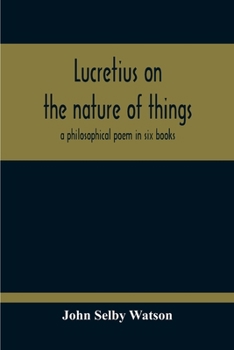
Lucretius On The Nature Of Things; A Philosophical Poem In Six Books

Lucretius speaks across two millennia with crystalline force. A vivid, philosophical song. It explains the universe plainly. Lucretius's On the Nature of Things, here rendered into English by John Selby Watson, is an epic philosophical poem in six books where poetic sweep and rigorous argument meet. Rooted in classical Latin literature and the rhythms of ancient Roman poetry, the poem sets out Epicurean philosophy themes: cosmology, atomism, sensation, and the ethical solace that follows from understanding mortality. Watson's translation keeps the lyric thrust of the original while guiding modern readers through argument and image, so that the origins of matter and the nature of the universe are both intellectually present and sensorially vivid. Readers come for philosophy and stay for the music of the lines. Its blend of image and inquiry makes it both a historical document and a living poem: you encounter early scientific imagination alongside moments of pure lyric. For contemporary readers, the poem's investigation of the origins of matter reads as a striking precursor to later natural philosophy, offering context to modern debates about matter and mind. As one of the landmark Roman philosophical works from the first century BCE, De Rerum Natura stands with Virgil era literature and the prose of Cicero, and it richly rewards readers tracing ideas across the late Republic. It functions as effective Cicero companion reading while standing on its own as a central text for courses in classical thought, a practical classical studies reference and a highlight for any philosophy students collection. Accessible to casual readers and prized by classic-literature collectors, it offers lucid explanation and memorable imagery in equal measure. Republished by Alpha Editions in a careful modern edition, this volume preserves the spirit of the original while making it effortless to enjoy today - a heritage title prepared for readers and collectors alike.
Format:Paperback
Language:English
ISBN:9354211976
ISBN13:9789354211973
Release Date:November 2020
Publisher:Alpha Edition
Length:522 Pages
Weight:1.67 lbs.
Dimensions:1.2" x 6.0" x 9.0"
Customer Reviews
1 rating
As with all Greek writings, the Translator makes a difference. translated by John Selby Watson (1868
Published by bernie4444 , 1 month ago
Just as in the Iliad by Homer, the translation can make a significant difference in what you are reading. With “De Rerum natura” or “The Nature of Things” by Lucretius, a glaring difference is that the word “matter” can also be the word “atom,” depending on the translation. I will not go through the different translations here, but you need to be aware and probably try different translations.
My favorite translation is “New Verse Translation” by Ian Johnston. It looks like the sample shown for the Kindle is this translation. If you can find it, Hugh Ross reads a good 7-CD version. Some Kindle versions have text-to-speak.
Titus Lucretius Carus, born around 99 BCE, has a good handle on “The Nature of Things,” a poem written in some 7,400 dactylic hexameters, and he makes a good argument for the existence of things and how they work. He goes on to dabble in all things from celestial and terrestrial phenomena.
He had to do this without knowing that the 21st century has instruments and ways to know more than our senses with accuracy and application. He would not know of the quantum world.
I suspect this book was on Darwin’s bedside table.
Copyright © 2026 Thriftbooks.com
Terms of Use | Privacy Policy | Do Not Sell/Share My Personal Information | Cookie Notice | Cookie Preferences | Accessibility Statement
ThriftBooks ® and the ThriftBooks ® logo are registered trademarks of Thrift Books Global, LLC
ThriftBooks ® and the ThriftBooks ® logo are registered trademarks of Thrift Books Global, LLC
