


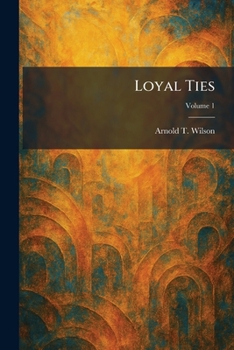
Loyal Ties

"Loyal Ties" (Volume 1) offers a comprehensive and firsthand account of the British civil administration and military campaigns in Mesopotamia during the critical years of World War I. Written by Sir Arnold T. Wilson, a prominent figure in the British colonial service and an active participant in the events described, this work provides an invaluable perspective on the geopolitical shifts that reshaped the Middle East in the early twentieth century.
The narrative delves into the complexities of governing a region under transition, detailing the interactions between British forces and the local populations. Wilson provides meticulous documentation of the challenges faced by administrators, the strategic importance of the Mesopotamian campaign, and the evolving political landscape that led to the establishment of the British Mandate. From military logistics to diplomatic negotiations, the text serves as a primary source for understanding the foundations of modern Iraq.
As a historical record, "Loyal Ties" captures the tensions and aspirations of an era marked by empire and emerging nationalism. Scholars and enthusiasts of military history, Middle Eastern studies, and international relations will find this volume to be a rigorous and detailed examination of a pivotal moment in global history.
This work has been selected by scholars as being culturally important, and is part of the knowledge base of civilization as we know it. This work was reproduced from the original artifact, and remains as true to the original work as possible. Therefore, you may see the original copyright references, library stamps (as most of these works have been housed in our most important libraries around the world), and other notations in the work.
This work is in the public domain in the United States of America, and possibly other nations. Within the United States, you may freely copy and distribute this work, as no entity (individual or corporate) has a copyright on the body of the work.
As a reproduction of a historical artifact, this work may contain missing or blurred pages, poor pictures, errant marks, etc. Scholars believe, and we concur, that this work is important enough to be preserved, reproduced, and made generally available to the public. We appreciate your support of the preservation process, and thank you for being an important part of keeping this knowledge alive and relevant.
Customer Reviews
ThriftBooks ® and the ThriftBooks ® logo are registered trademarks of Thrift Books Global, LLC
