


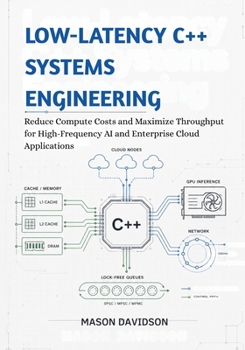
Low-Latency C++ Systems Engineering: Reduce Compute Costs and Maximize Throughput for High-Frequency AI and Enterprise Cloud Applications

When milliseconds inflate cloud bills, stall AI workflows, and weaken user experience, ordinary C++ performance tuning is not enough. Modern enterprise systems need software that moves closer to the hardware, reduces waste, and delivers predictable speed under extreme concurrency.
Low-Latency C++ Systems Engineering is a practical guide to building high-performance C++ infrastructure for AI systems, enterprise cloud platforms, MCP servers, GPU inference pipelines, and high-throughput network services. It shows how to design C++ systems that cut unnecessary allocations, reduce data copying, improve CPU cache behavior, harden memory safety, and scale across demanding production environments.
Inside, readers will learn how to:
Build hardened C++26 architectures with safer contracts, RAII, and modern resource managementDesign zero-copy memory systems, cache-aligned data structures, and lock-free queuesUse io_uring, non-blocking sockets, and tuned network buffers for low-latency servicesCreate performance-critical MCP servers for AI agents and multi-agent workflowsOptimize AI inference with TensorRT, ONNX Runtime, quantization, and asynchronous C++ pipelinesAdd observability, latency benchmarking, regression testing, and cost-aware cloud automationReduce compute waste while maximizing throughput across enterprise cloud infrastructureWritten for C++ engineers, systems programmers, AI infrastructure developers, cloud architects, and performance-focused teams, this book connects low-level engineering decisions to real business outcomes: faster applications, lower infrastructure costs, better reliability, and stronger production control.
Customer Reviews
ThriftBooks ® and the ThriftBooks ® logo are registered trademarks of Thrift Books Global, LLC
