


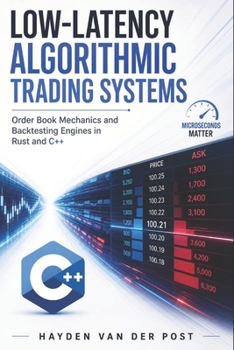
Low-Latency Algorithmic Trading Systems: Order Book Mechanics and Backtesting Engines in Rust and C++

Low-Latency Algorithmic Trading Systems: Order Book Mechanics and Backtesting Engines in Rust and C++ provides a rigorous, implementation-focused blueprint for designing ultra-low-latency execution architecture, high-throughput market data pipelines, and deterministic backtesting systems.
Modern quantitative execution demands microsecond and nanosecond precision. Standard high-level languages introduce garbage collection pauses, memory footprint bloat, and runtime overhead that compromise execution speed. This book bridges the gap between theoretical market mechanics and production-grade system implementation using C++20 and Rust.
What You Will Learn:
Order Book Mechanics: Design high-speed L2 and L3 Limit Order Books (LOB) optimized for cache locality, minimal memory allocation, and fast order matching.Market Data Ingestion: Implement asynchronous, lock-free network routines to parse market data protocols (FIX, FAST, ITCH, OUCH) with zero-copy deserialization.Deterministic Backtesting Engines: Construct event-driven backtesting architectures that accurately account for order queue priority, slippage, market impact, and latency simulation.Rust and C++ Interoperability: Capitalize on modern C++20 memory management and Rust memory safety primitives to eliminate race conditions without sacrificing throughput.System-Level Optimization: Utilize CPU affinity, cache line alignment, lock-free data structures, and kernel bypass concepts to maintain deterministic execution under extreme market volatility.Whether you are a quantitative developer, software engineer, or system architect transitioning into algorithmic trading, this guide delivers the core software engineering principles required to build reliable, high-frequency infrastructure.
Customer Reviews
ThriftBooks ® and the ThriftBooks ® logo are registered trademarks of Thrift Books Global, LLC
