


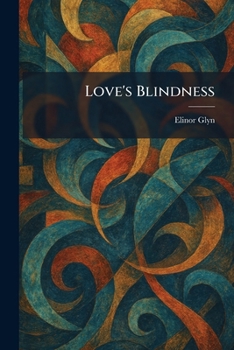
Love's Blindness

Select Format
Select Condition 
Book Overview
"Love's Blindness" is a compelling exploration of romance, social hierarchy, and the complexities of the human heart by the celebrated Elinor Glyn. Set against the backdrop of high-society expectations and financial desperation, the story follows the life of a nobleman forced into a marriage of convenience to settle his family's debts. When Lord St. Austel agrees to wed the daughter of a wealthy moneylender, he expects only a cold arrangement to preserve his heritage. However, the union proves to be more than a mere transaction.
Glyn masterfully weaves a tale of internal conflict as the protagonists navigate their initial prejudices and the rigid constraints of their social standing. As the title suggests, the novel delves into the transformative power of affection and how true intimacy can often be obscured by pride and class distinctions. "Love's Blindness" captures the essence of early 20th-century romantic fiction, showcasing the wit, drama, and emotional intensity that made Glyn a household name.
Readers will find themselves immersed in a world of aristocratic glamor and deep-seated longing. Through elegant prose and sharp social observation, the work examines whether a bond born of necessity can blossom into genuine devotion, making it a classic example of the era's romantic literature.
This work has been selected by scholars as being culturally important, and is part of the knowledge base of civilization as we know it. This work was reproduced from the original artifact, and remains as true to the original work as possible. Therefore, you may see the original copyright references, library stamps (as most of these works have been housed in our most important libraries around the world), and other notations in the work.
This work is in the public domain in the United States of America, and possibly other nations. Within the United States, you may freely copy and distribute this work, as no entity (individual or corporate) has a copyright on the body of the work.
As a reproduction of a historical artifact, this work may contain missing or blurred pages, poor pictures, errant marks, etc. Scholars believe, and we concur, that this work is important enough to be preserved, reproduced, and made generally available to the public. We appreciate your support of the preservation process, and thank you for being an important part of keeping this knowledge alive and relevant.
Customer Reviews
ThriftBooks ® and the ThriftBooks ® logo are registered trademarks of Thrift Books Global, LLC
