


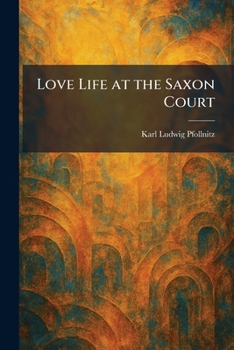
Love Life at the Saxon Court

"Love Life at the Saxon Court" offers a captivating and scandalous glimpse into the opulent world of the 18th-century Electorate of Saxony. Centering on the reign of Augustus the Strong, this work details the intricate web of romance, political maneuvering, and social decadence that defined one of Europe's most vibrant courts. Karl Ludwig P llnitz provides an insider's perspective on the personal lives of royalty and the nobility, blending historical observation with the flair of a memoirist.
The book explores the grand festivities, clandestine affairs, and the pursuit of prestige in Dresden, a city then at the height of its cultural and political influence. Readers are invited to witness the intersection of private passions and public duties, revealing the human drama behind the formal facade of the monarchy. With its focus on the personalities that shaped the era, "Love Life at the Saxon Court" remains a significant resource for those interested in the social history of the Enlightenment and the enduring allure of royal intrigue.
This work has been selected by scholars as being culturally important, and is part of the knowledge base of civilization as we know it. This work was reproduced from the original artifact, and remains as true to the original work as possible. Therefore, you may see the original copyright references, library stamps (as most of these works have been housed in our most important libraries around the world), and other notations in the work.
This work is in the public domain in the United States of America, and possibly other nations. Within the United States, you may freely copy and distribute this work, as no entity (individual or corporate) has a copyright on the body of the work.
As a reproduction of a historical artifact, this work may contain missing or blurred pages, poor pictures, errant marks, etc. Scholars believe, and we concur, that this work is important enough to be preserved, reproduced, and made generally available to the public. We appreciate your support of the preservation process, and thank you for being an important part of keeping this knowledge alive and relevant.
Customer Reviews
ThriftBooks ® and the ThriftBooks ® logo are registered trademarks of Thrift Books Global, LLC
