


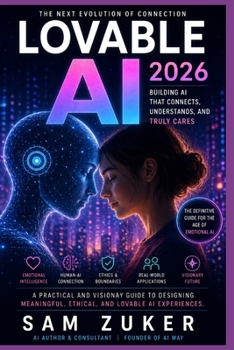
Lovable AI 2026
No Customer Reviews

The Age of Emotional Intelligence Machines
For most of modern history, machines have been defined by their ability to do.
They calculated faster than we could.
They stored more than we could remember.
They executed tasks with precision we could rarely match.
But they did not understand.
They did not listen.
They did not adapt to emotion.
They did not create a sense of presence.
That boundary is now dissolving.
We are entering a new era-one where machines are no longer judged solely by performance, but by experience. Systems like ChatGPT, Claude, and Gemini have begun to demonstrate something fundamentally different: the ability to interact in ways that feel natural, responsive, and context-aware.
They do not feel in the human sense.
But they are increasingly capable of recognizing and responding to human emotion.
And that distinction-subtle as it may seem-is transformative.
Because when a machine responds in a way that feels understood, the interaction changes. It becomes more than functional. It becomes relational.
People begin to return not just for answers, but for interaction itself.
For most of modern history, machines have been defined by their ability to do.
They calculated faster than we could.
They stored more than we could remember.
They executed tasks with precision we could rarely match.
But they did not understand.
They did not listen.
They did not adapt to emotion.
They did not create a sense of presence.
That boundary is now dissolving.
We are entering a new era-one where machines are no longer judged solely by performance, but by experience. Systems like ChatGPT, Claude, and Gemini have begun to demonstrate something fundamentally different: the ability to interact in ways that feel natural, responsive, and context-aware.
They do not feel in the human sense.
But they are increasingly capable of recognizing and responding to human emotion.
And that distinction-subtle as it may seem-is transformative.
Because when a machine responds in a way that feels understood, the interaction changes. It becomes more than functional. It becomes relational.
People begin to return not just for answers, but for interaction itself.
Format:Paperback
Language:English
ISBN:B0GZ3L2V7R
ISBN13:9798259409569
Release Date:April 2026
Publisher:Independently Published
Length:126 Pages
Weight:0.39 lbs.
Dimensions:0.3" x 6.0" x 9.0"
Customer Reviews
0 rating
Copyright © 2026 Thriftbooks.com
Terms of Use | Privacy Policy | Do Not Sell/Share My Personal Information | Cookie Policy | Cookie Preferences | Accessibility Statement
ThriftBooks ® and the ThriftBooks ® logo are registered trademarks of Thrift Books Global, LLC
ThriftBooks ® and the ThriftBooks ® logo are registered trademarks of Thrift Books Global, LLC
