


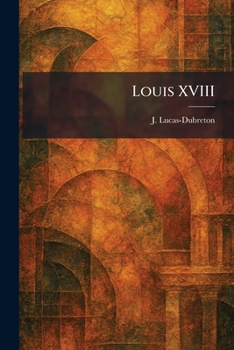
Louis XVIII

Select Format
Select Condition 
Book Overview
"Louis XVIII" by J. Lucas-Dubreton offers a comprehensive and engaging look into the life and reign of the monarch who sat on the throne of France during one of its most turbulent eras. Following the upheaval of the French Revolution and the subsequent rise and fall of Napoleon Bonaparte, Louis XVIII returned to France to lead the Bourbon Restoration. This biography delves into the complexities of a ruler caught between the desire to restore the ancient traditions of the monarchy and the necessity of acknowledging the new liberal realities of a post-revolutionary society.
Lucas-Dubreton masterfully portrays the character of the king, illustrating his intellectual prowess, his diplomatic maneuvering, and the physical challenges that marked his later years. The narrative spans his long period of exile across Europe, his brief return during the first Restoration, and the final stabilization of his reign after the Battle of Waterloo. As a historical work, "Louis XVIII" provides essential context for understanding the fragile balance of power in 19th-century Europe and the evolution of constitutional monarchy in France. This study remains a significant resource for readers interested in French history, royal biographies, and the political shifts that defined the post-Napoleonic world.
This work has been selected by scholars as being culturally important, and is part of the knowledge base of civilization as we know it. This work was reproduced from the original artifact, and remains as true to the original work as possible. Therefore, you may see the original copyright references, library stamps (as most of these works have been housed in our most important libraries around the world), and other notations in the work.
This work is in the public domain in the United States of America, and possibly other nations. Within the United States, you may freely copy and distribute this work, as no entity (individual or corporate) has a copyright on the body of the work.
As a reproduction of a historical artifact, this work may contain missing or blurred pages, poor pictures, errant marks, etc. Scholars believe, and we concur, that this work is important enough to be preserved, reproduced, and made generally available to the public. We appreciate your support of the preservation process, and thank you for being an important part of keeping this knowledge alive and relevant.
Customer Reviews
ThriftBooks ® and the ThriftBooks ® logo are registered trademarks of Thrift Books Global, LLC
