


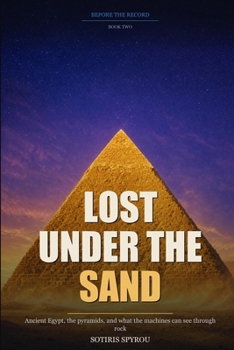
Lost Under the Sand: Ancient Egypt, the pyramids, and what the machines can see through rock

In 2017 a team counted cosmic ray particles passing through the Great Pyramid and found a void above the Grand Gallery roughly 30 metres long. It is the single strongest argument for machine-assisted archaeology anybody has, and this book takes it seriously enough to check it properly.
It also tells you what almost nobody repeating that result mentions: the same technique was pointed at a different pyramid in 1970 and found nothing at all. Three independent teams, three different detectors, and a blank. Both results are real. Only one of them gets retold.
Radar, satellite survey and muon tomography across Egypt and the Sahara, each explained properly and then asked the same four questions: how much was covered, what was recovered, what did the researchers say about what they could not see, and did anybody check it independently.
A method that works and a method that is known to work are two different claims, and the gap between them is where this book lives.
Sotiris Spyrou runs machine-assisted landscape surveys and publishes what they miss as well as what they find. One recall figure in his own work turned out to be indistinguishable from scattering points at random. It is printed in this book, beside the baseline that killed it.
Every factual claim carries one of five confidence labels. Every source is cited with a DOI you can look up. The back matter lists every claim that could not be verified at all.
Customer Reviews
ThriftBooks ® and the ThriftBooks ® logo are registered trademarks of Thrift Books Global, LLC
