


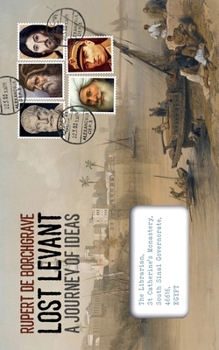
Lost Levant: A Journey of Ideas

How do we understand the heritage of the Levant? In 2003 Rupert de Borchgrave set off by local public transport from London to Mount Ararat with a backpack and a sack of books. Against the backdrop of the Second Gulf War, he examined the much-disputed territory on which the ancient world constructed its philosophical, religious, mathematical and artistic thinking and considered what the region gave to Western civilisation.
His narrative unfolds across 24 chapters, capturing encounters with diverse people along the way, from a Sicilian opera singer to a Tunisian chicken farmer, from a dissident Libyan physician to a retired English diplomat in Siwa oasis, from an Orthodox monk at Sinai to a Jordanian princess.
These encounters form a series of vignettes, in the tradition of ancient epics from The Odyssey to The Epic of Gilgamesh, framing the journey as a modern pilgrimage through lands steeped in history and cultural significance.
The essays in the first half are concerned with existentialist philosophy and religious history. In Rome, the subject is Christianity; in Pompeii, the thought of Epicurus; in Syracuse, an essay on Archimedes leads to a discussion about infinity and mathematical 'fit' in natural science. In Siwa, Khaldunian ideas are presented; in Alexandria the subjects are the history of the 'logos' and the desert fathers; the Cairo chapter develops the book's themes; while in Sinai, heterodoxy, Platonism and mysticism are discussed.
The essays in the second half are focussed on political economy and the history of the Greater Levant. In Jordan, the author explores the origins of Islam, the crusades, Israel and inter-religious dialogue; in the Damascus chapters, he elaborates a theory of 'Epicurean economics'. In Aleppo he discusses the influence of ancient Iraq on Greek civilisation, and the Syria chapters close with an account of the Syrian Civil War, relating these tragic events to the earlier essays.
Antioch addresses pagans versus Christians, and democracy versus autocracy. The final sections explore the worlds of the Syriacs and Armenians in Upper Mesopotamia and eastern Turkey, before reaching Mount Ararat and touching on Sufism in Konya.
Lost Levant reinterprets Christianism as the forerunner of secular liberal democracy, contrasting it with social Darwinist capitalism, globalist libertarianism and autocratic kleptocracy, and advocates for a theory of political economy termed 'Epicurean economics'. The book discusses cultural innovation as the continuous expression of what Hegel called the 'world spirit' - the unfolding illumination of logos - to work to the end of an optimal political economy rooted in 'libert , galit , fraternit '.
The journey to Ararat reflects the author's belief that while humanity's challenges evolve, the ancient questions-about faith, freedom and meaning-are still essential, and addressing them can lead us toward a more compassionate and thoughtful world.
Customer Reviews
ThriftBooks ® and the ThriftBooks ® logo are registered trademarks of Thrift Books Global, LLC
