


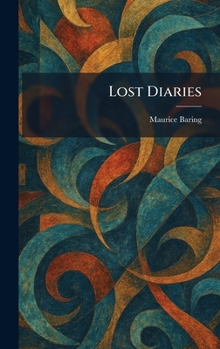
Lost Diaries

"Lost Diaries" is a brilliant collection of satirical sketches that playfully reimagines the private journals of some of history and literature's most iconic figures. Through the clever lens of Maurice Baring, readers are granted access to the supposed secret thoughts of characters ranging from Hamlet and Christopher Columbus to King Cophetua and Iseult of Brittany.
The work excels as a series of literary pastiches, where Baring employs his characteristic wit and deep erudition to mimic the voices of different eras and archetypes. Each entry serves as a sharp, humorous commentary on the human condition, often stripping away the legendary status of its subjects to reveal their mundane anxieties, domestic frustrations, and hidden motivations. By subverting the expectations of the traditional diary format, Baring creates a work that is both an entertaining exercise in historical imagination and a sophisticated critique of biographical tropes. "Lost Diaries" remains a testament to Baring's versatility as a writer and his unique ability to blend high-culture references with accessible, lighthearted humor.
This work has been selected by scholars as being culturally important, and is part of the knowledge base of civilization as we know it. This work was reproduced from the original artifact, and remains as true to the original work as possible. Therefore, you may see the original copyright references, library stamps (as most of these works have been housed in our most important libraries around the world), and other notations in the work.
This work is in the public domain in the United States of America, and possibly other nations. Within the United States, you may freely copy and distribute this work, as no entity (individual or corporate) has a copyright on the body of the work.
As a reproduction of a historical artifact, this work may contain missing or blurred pages, poor pictures, errant marks, etc. Scholars believe, and we concur, that this work is important enough to be preserved, reproduced, and made generally available to the public. We appreciate your support of the preservation process, and thank you for being an important part of keeping this knowledge alive and relevant.
Customer Reviews
ThriftBooks ® and the ThriftBooks ® logo are registered trademarks of Thrift Books Global, LLC
