


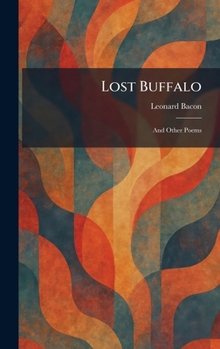
Lost Buffalo: And Other Poems

"Lost Buffalo: And Other Poems" is a compelling collection of verse by Leonard Bacon, a poet known for his sharp wit and technical mastery. This volume captures a transition in the American consciousness, blending traditional poetic forms with themes that reflect the shifting landscape of the early twentieth century. The titular poem, "Lost Buffalo," serves as a poignant exploration of the American West, evoking the spirit of a vanished frontier and the ecological and cultural changes that followed in the wake of modernization.
Bacon's poetry in this collection ranges from satirical observations to lyrical reflections, showcasing his ability to navigate diverse emotional and intellectual terrains. The works are characterized by their rhythmic precision and intellectual depth, offering readers a glimpse into the literary sensibilities of an era grappling with its past while moving rapidly toward an uncertain future. For enthusiasts of American literature and classic poetry, "Lost Buffalo: And Other Poems" stands as a significant contribution to the canon, preserving the voice of a writer who bridged the gap between traditional aesthetics and modern themes.
This work has been selected by scholars as being culturally important, and is part of the knowledge base of civilization as we know it. This work was reproduced from the original artifact, and remains as true to the original work as possible. Therefore, you may see the original copyright references, library stamps (as most of these works have been housed in our most important libraries around the world), and other notations in the work.
This work is in the public domain in the United States of America, and possibly other nations. Within the United States, you may freely copy and distribute this work, as no entity (individual or corporate) has a copyright on the body of the work.
As a reproduction of a historical artifact, this work may contain missing or blurred pages, poor pictures, errant marks, etc. Scholars believe, and we concur, that this work is important enough to be preserved, reproduced, and made generally available to the public. We appreciate your support of the preservation process, and thank you for being an important part of keeping this knowledge alive and relevant.
Customer Reviews
ThriftBooks ® and the ThriftBooks ® logo are registered trademarks of Thrift Books Global, LLC
