


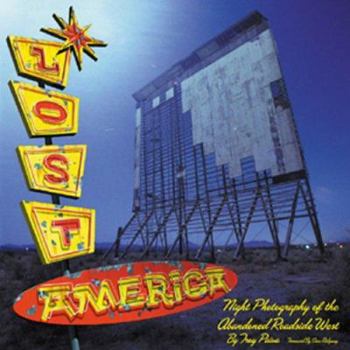
Lost America: The Abandoned Roadside West

Select Format
Select Condition 
Book Overview
A stunningly photographed examination of the roadside icons that dot America's landscape. Lost America celebrates the boom-to-bust towns, aircraft bone yards, and filling stations of days past that... This description may be from another edition of this product.
Format:Paperback
Language:English
ISBN:076031490X
ISBN13:9780760314906
Release Date:January 2003
Publisher:Motorbooks Intl
Length:128 Pages
Weight:1.66 lbs.
Dimensions:9.3" x 0.5" x 9.3"
Customer Reviews
5 ratings
Haunting, Riveting Images of Abandoned Popular Culture.
Published by Thriftbooks.com User , 22 years ago
After years of admiring Troy Paiva's photography on his website, I was thrilled to find that a collection of his unique images is finally available in print. For those unfamiliar with Paiva's work, he takes color pictures of long-abandoned buildings and machines at night, under moonlight, and provides additional illumination with splashes of brightly colored flash. If that sounds gaudy or just plain odd, it probably is. And although I'm normally a fan of subdued colors and black-and-white photography, Troy Paiva's work has always captivated me. A lot of photographers take pictures of decay. And taken under sunlight by any other photographer, that's what these images would look like. But decay is only part of the story. Troy Paiva had a stroke of genius when he determined that darkness and garish color would turn his images of junk into vital accounts of American technologies and ideas whose life cycle has been spent. His lighting techniques make the structures seem haunted. Not by ghosts, but by cultures long departed. Ugly things are made eerily riveting, if not actually beautiful. "Lost America" contains five sections: "Where the Lanes Are Wide" (photographs of abandoned Miracle Mile towns), "Drive In, Drive Out" (you guessed it, drive-in movie theaters), "The Last Resort" (The Salton Sea), and "Salvage" (machines with one foot in the grave). Troy Paiva introduces each section with an excellent essay detailing the history of the subject and its demise. The essays are fluid and informative. Mr. Paiva turns out to be one of those photographers who writes the text for his photographs better than anyone else could. There are about 90 5"x7 1/2" color photographs in this book, all with explanatory captions, and some smaller black-and-white photographs as well. I have really enjoyed looking at these images over and over again. My only misgiving about the book is that I wish it were hardcover and perhaps a little larger. Nevertheless, no fan or practitioner of photography should be without Troy Paiva's haunting historic images. Aficionados of 20th Century popular culture may also find "Lost America" valuable for its graphic representation of how cultures and their icons came and then passed into oblivion. Highly recommended.
Outstanding photostory of disappearing America
Published by Thriftbooks.com User , 22 years ago
Troy Paiva has been photographing abandoned buildings for over ten years. But unlike David Plowden, who favors the industrial rust-belt buildings under overcast skies, Paiva centers on the small, roadside buildings of Southern California, Nevada, Arizona and New Mexico; the mom-and-pop grocery stores, gas stations, and drive-in theaters that have been left in the desert to decay a slow, dry death. Although this book is interesting to anyone who's a fan of either Route 66 memorabilia or the history of roadside America, the most stunning aspect of this book is that all of the photographs were taken at night, usually under a full moon with the aid of well-placed color strobes. And while a Hollywood production company would flood these buildings with enough light to make it look like daytime, Troy Paiva selectively adds just enough colored light to draw the buildings out of the darkness and render some sense of mystery to the scenes.I'd highly recommend this book to anyone who's interested in abandonded buildings, roadside America and night photography.
Bones of Progress Passed
Published by Thriftbooks.com User , 22 years ago
Speaking as a published photographer, this book of unusual night photography is very, very impressive, and highly recommended. On first look, this appears to be portfolio of artsy night photographs of rusty junk that's been abandoned in the desert and photographed by a roving lost soul. But it's much more than that. It's a diary of Lost America, and an ode to the innovation and creativity of The American Spirit.Paiva will take you on a strange journey that he's been traveling for more than 10 years, through the graveyards of a world that no longer exists, except in our memories, and in these photographs, which are unlike anything you've ever seen. Yes, these are photographs of long-abandoned leading-edge technological innovations of their time - which we now call junk -- but they are also pictures of places, long ago abandoned by people who had bigger hopes and dreams. What we don't know is whether their dreams ended in tragedy, or whether they abandoned what they saw as worthless baubles of an industrial America in constant state of creative destruction and transition, to move onward and upward to better things. And thus these photographs become palettes for our imaginations.Behind every picture, there is a story, and Paiva's five outstanding essays provide some of that story by providing insight to the transitions of American culture over the past 50 years or so, as well as adding his uniquely humorous, sentimental - and sometimes scary - outlook on his photo subjects. He also weaves enough autobiographical information into his poetic prose to provide us with glimpses into the soul of a man who enjoys taking 3,000 mile road trips in four days under a full moon, and barreling down Interstate highways with the stereo pounding, while sleepy, punchy, and covered with sweat and desert grit. My favorite is this: "Salvage yards are some of my favorite places to haunt. You get the feeling that these objects are all staring at you, imploring you to put them out of their misery. If machines have souls, then junkyards are filled with their ghosts, confused and trapped in the purgatory between useful life and their ultimate demise in the smelter." After reading the essays and viewing the pictures, Paiva's success in capturing his vision of Lost America may change the way you view the world of junk, forevermore. The 100 plus color pictures, all shot on 35mm film and presented without digital or darkroom enhancements, are each captioned with flair and personality. For example, when was the last time you saw the work "gimpy" in print, as in : "A gimpy starburst light fixture rises above the other battered and faded signs in the blistering desert sun of Las Vegas' sign graveyard" (p.101). In addition to the photos and essays and personal observations and biography, there is an Introduction by Stan Ridgway, former Wall of Voodoo performing who's recent CD Holiday In Dirt is adorned with a Paiva-shot photo. He captures the essence of Paiva's photo essay
Can't wait for part II...
Published by Thriftbooks.com User , 22 years ago
I have been a fan of lostamerica.com for a long time. The night photography is just incredible! What took me by suprise in "Lost America: The Abandoned Roadside West" is the wonderful, descriptive, passages that author Troy Paiva has included describing his 100 mph journeys thru the Lost America. Not only is Paviva an expert photographer, (these photos are beyond description, you must see them) he is an artist with his words. You almost can feel the desert heat, the sand filled wind against your face...Just a wonderful reading experience. I hope a part II is in the works!
Lost America Rules!!
Published by Thriftbooks.com User , 22 years ago
I've been a fan of Troy Paiva's night photography for years. It's ethereal, it's mysterious, it's almost supernatural. The Abandoned Roadside West is his recurrent theme: ghost towns, derelict drive-ins and motels, airplane graveyards, and other places in our own country that we would never otherwise see, or even guess at their existence.How does he do it? He works at it. Over the years he developed his own system of long-exposure night photography that uses strategically placed colored strobes to light the most unusual and out-of-the-way locales imaginable, which he researches and tracks down during week-long expeditions through the forgotten desert highways of the West in his trusty Subaru SUV. Paiva, a former toy designer, is like no one else. He possesses a sardonic view of the world and a maniacal sense of humor. His esthetic is informed by kitsch, camp, television, toys, modern architecture, the pop culture of the fifties and sixties, and his extensive formal training in design and technology. How this mixture of traits and influences yields such hauntingly beautiful images is a mystery you will want to check out.
Copyright © 2026 Thriftbooks.com Terms of Use
| Privacy Policy | Do Not
Sell/Share My Personal Information | Cookie Policy | Cookie Preferences | Accessibility Statement
ThriftBooks® and the ThriftBooks® logo are registered trademarks of Thrift Books Global, LLC
ThriftBooks® and the ThriftBooks® logo are registered trademarks of Thrift Books Global, LLC
