


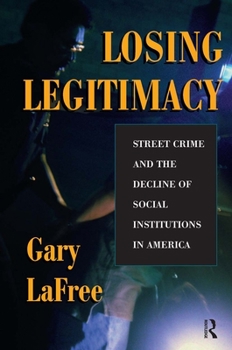
Losing Legitimacy: Street Crime and the Decline of Social Institutions in America

Select Format
Select Condition 
Book Overview
In the past fifty years, street crime rates in America have increased eightfold. These increases were historically patterned, were often very rapid, and had a disproportionate impact on African Americans. Much of the crime explosion took place in a space of just ten years beginning in the early 1960s. Common explanations based on biological impulses, psychological drives, or slow-moving social indicators cannot explain the speed or timing of these changes or their disproportionate impact on racial minorities. Using unique data that span half a century, Gary LaFree argues that social institutions are the key to understanding the U.S. crime wave. Crime increased along with growing political distrust, economic stress, and family disintegration. These changes were especially pronounced for racial minorities. American society responded by investing more in criminal justice, education, and welfare institutions. Stabilization of traditional social institutions and the effects of new institutional spending account for the modest crime declines of the 1990s.
Format:Paperback
Language:English
ISBN:0813334519
ISBN13:9780813334516
Release Date:November 1999
Publisher:Routledge
Length:260 Pages
Weight:0.75 lbs.
Dimensions:0.5" x 6.0" x 9.0"
Customer Reviews
1 rating
The best book explaining the causes of crime, period.
Published by Thriftbooks.com User , 19 years ago
As all of us over a certain age know, crime was once perhaps the most important political issue in America. There was a huge increase in crime, during the 1960s and thereafter. For a time there, everyone was afraid of crime, and this made it a huge issue. This was then followed by a huge decrease in crime, during the 1990s and after. As a result, crime has faded as a political concern. The increase in crime is not at all well understood. The most popular explanation is that crime is caused by poverty and other "root causes." This explanation, however, does not explain why crime went up dramatically during the 1960s, during a time when poverty was decliing. Professor LaFree carefully studies all of the different explanations of the crime increase, and considers the evidence for and against them. He argues that the increase in crime was due to the general decrease in the legitimacy of the social order during the 1960s. I think he makes a compelling case. He does not address the causes of the decrease in crime, since the mid 1990s, probably because this book was published in 1998. If you want an explanation of the decrease, this is not your book. However, if you want an explanation of the prior run up in crime, this is by far the best book on the subject, and I have read quite a few books on the subject. One aspect of this book which I should mention is its relative lack of trendy academic posturing. As a counter example, a far better known book on a very similar subject is Bernard Harcourt's Illusion of Order: The False Promise of Broken Windows Policing. That is a deeply dishonest book intellectually, because it is based upon fashionable post-modern thought. LaFree is not a post-modern. He is deeply read in 20th century social science, and he takes very seriously such earlier thinkers as Durkheim. Among the other pleasures of reading his book, he gives a very good overview of prior thinkers on this and related subjects.
Copyright © 2025 Thriftbooks.com
Terms of Use | Privacy Policy | Do Not Sell/Share My Personal Information | Cookie Policy | Cookie Preferences | Accessibility Statement
ThriftBooks ® and the ThriftBooks ® logo are registered trademarks of Thrift Books Global, LLC
ThriftBooks ® and the ThriftBooks ® logo are registered trademarks of Thrift Books Global, LLC
