


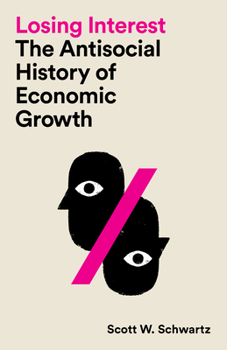
Losing Interest: The Antisocial History of Economic Growth
No Customer Reviews

Nothing about endless capitalist growth is normal.
Across thousands of years of human history, most cultures have placed explicit social and moral restrictions on economic growth, with charging interest scorned as benefiting from another's hardship and profit-making as divisive. So how did interest rates, monetary gains, and return on investment come to rule our modern world?Though most economic histories tell this story as one of overcoming superstition in favor of social progress, Losing Interest explains how the concept of "interest" had to be continuously rehabilitated over six centuries of European colonial expansion, transforming profit from a mortal sin into a business model. From early Medici innovations in banking to the development of insurance schemes in the trans-Atlantic slave trade, our current economic system was built on legal and financial tools that abstract capital from the ongoing reality of deception, theft, and mass murder at its core.With wit and lyricism, anthropologist Scott W. Schwartz makes a clear, commonsense appeal for our shared wellbeing against capitalism's nonsensical demand for widespread suffering to produce the mounting wealth of the few. In the spirit of David Graeber, Thomas Piketty, and Kohei Saito, Losing Interest serves as a prequel to contemporary degrowth literature, illuminating the history and mechanics of how interest has risen to take from the poor and give to the rich.
Across thousands of years of human history, most cultures have placed explicit social and moral restrictions on economic growth, with charging interest scorned as benefiting from another's hardship and profit-making as divisive. So how did interest rates, monetary gains, and return on investment come to rule our modern world?Though most economic histories tell this story as one of overcoming superstition in favor of social progress, Losing Interest explains how the concept of "interest" had to be continuously rehabilitated over six centuries of European colonial expansion, transforming profit from a mortal sin into a business model. From early Medici innovations in banking to the development of insurance schemes in the trans-Atlantic slave trade, our current economic system was built on legal and financial tools that abstract capital from the ongoing reality of deception, theft, and mass murder at its core.With wit and lyricism, anthropologist Scott W. Schwartz makes a clear, commonsense appeal for our shared wellbeing against capitalism's nonsensical demand for widespread suffering to produce the mounting wealth of the few. In the spirit of David Graeber, Thomas Piketty, and Kohei Saito, Losing Interest serves as a prequel to contemporary degrowth literature, illuminating the history and mechanics of how interest has risen to take from the poor and give to the rich.
Format:Paperback
Language:English
ISBN:1849356505
ISBN13:9781849356503
Release Date:April 2026
Publisher:AK Press
Length:236 Pages
Weight:0.71 lbs.
Dimensions:0.9" x 5.4" x 8.4"
Customer Reviews
0 rating
Copyright © 2026 Thriftbooks.com
Terms of Use | Privacy Policy | Do Not Sell/Share My Personal Information | Cookie Policy | Cookie Preferences | Accessibility Statement
ThriftBooks ® and the ThriftBooks ® logo are registered trademarks of Thrift Books Global, LLC
ThriftBooks ® and the ThriftBooks ® logo are registered trademarks of Thrift Books Global, LLC
