


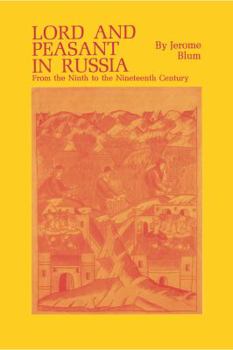
Lord and Peasant in Russia: From the 9th to the 19th Century

Select Format
Select Condition 
Book Overview
To understand Russian history without understanding serfdom--the peasant-lord relationship that shaped Russia for centuries--is impossible. Still, before Jerome Blum, no scholar had tackled the subject in depth. Monumental in scope and pathbreaking in its analysis, Lord and Peasant in Russia garnered immediate attention upon its publication in 1961, a year that also marked the one hundredth anniversary of the emancipation of the Russian serfs. As one reviewer remarked, "No better book on the subject exists; it is indispensable to the serious student of Russia.? On a scale befitting Russia--a sixth of the earth's land mass--Blum's book explored in almost seven hundred pages the legal and social evolution of its predominantly agricultural population, the types of peasant status, and the multifaceted nature of the master-peasant relationship. More important, Blum was the first to articulate the necessity of placing serfs front and center in the study of Russian history. As a reviewer for the Economist wrote, "Mr. Blum has written not just a monograph on landlords and peasants in Russia but a history of Russia from a particular point of view. There is no denying that the history of a country where . . . a bare 13 percent of the population was urban can with impunity be written in terms of landlords and peasants." In 1962, it was awarded the Herbert Baxter Adams Prize of the American Historical Association; it remains a cornerstone of Russian historiography.
Format:Hardcover
Language:English
ISBN:0691051321
ISBN13:9780691051321
Release Date:October 1961
Publisher:Princeton University Press
Length:688 Pages
Weight:1.55 lbs.
Dimensions:1.3" x 8.2" x 5.5"
Related Subjects
Eastern Europe History Politics & Social Sciences Rural Russia Social Science Social Sciences Sociology WorldCustomer Reviews
2 ratings
An excellent resource
Published by Thriftbooks.com User , 25 years ago
This book is a history of Russian society as it evolved from the very beginnings of the Kievan period, through the end of serfdom in the 19th century. More particularly, it is a history of serfdom in Russia. Using many primary sources, the author examines trends in economics, agriculture and politics, to weave the tapestry of Russian development.I was greatly impressed by the author's familiarity with his sources, and his subject. He made clear the organization of Russian society, and how it changed for the Russian people throughout the years. Scant attention is paid to wars and whatnot, except as they affected the development of Russian society itself, which is quite refreshing. My one complaint about the book is that it is somewhat dry reading, but it is an excellent resource for understanding pre-modern Russia.This is a book that I would strongly recommend to anyone interested in Russian History.
Magisterial work of agrarian history
Published by Thriftbooks.com User , 25 years ago
No serious student of Russian or agrarian history can ignore this work. Blum, a prominent historian, set out to discover why serfdom in Russia was so abject and prolonged. Altogether a magisterial, highly readable work.
Copyright © 2026 Thriftbooks.com Terms of Use
| Privacy Policy | Do Not
Sell/Share My Personal Information | Cookie Policy | Cookie Preferences | Accessibility Statement
ThriftBooks® and the ThriftBooks® logo are registered trademarks of Thrift Books Global, LLC
ThriftBooks® and the ThriftBooks® logo are registered trademarks of Thrift Books Global, LLC
