


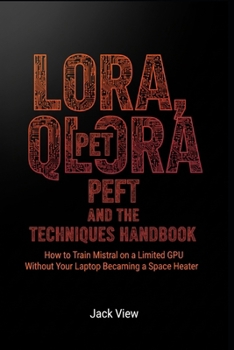
LoRA, QLoRA, and the PEFT Techniques Handbook: How to Train Mistral on a Limited GPU Without Your Laptop Becoming a Space Heater

LoRA, QLoRA, and the PEFT Techniques Handbook
How to Train Mistral on a Limited GPU Without Your Laptop Becoming a Space Heater
Training modern language models used to require a warehouse full of GPUs and a power bill that looked like a small country's GDP. Then researchers started asking a simpler question: what if we only trained the parts that actually matter?
LoRA, QLoRA, and the PEFT Techniques Handbook is a practical guide to parameter-efficient fine-tuning (PEFT) techniques that allow developers to customize powerful open-source models like Mistral without needing massive hardware. Instead of retraining billions of parameters, these methods focus on training tiny, strategic adapters that dramatically reduce memory usage and compute cost.
The book walks readers through the core techniques behind modern efficient model training, including Low-Rank Adaptation (LoRA) and QLoRA. With step-by-step explanations, practical workflows, and engineering tips, it shows how to fine-tune models using limited GPUs while keeping performance surprisingly competitive.
Topics include quantization strategies, adapter training, dataset preparation, memory optimization, and deployment pipelines that keep models lightweight enough for real-world use. Readers also learn how to avoid common pitfalls-like accidentally turning their laptops into high-temperature compute experiments.
Technical but approachable, this handbook is built for developers who want to push powerful AI models further without burning through hardware, electricity, or patience.
Because fine-tuning a language model should expand your model's capabilities-
not your electricity bill.
Customer Reviews
ThriftBooks ® and the ThriftBooks ® logo are registered trademarks of Thrift Books Global, LLC
