


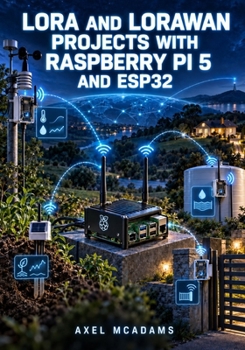
LORA AND LORAWAN PROJECTS WITH RASPBERRY PI 5 AND ESP32: Deploy a Chirpstack Gateway on Pi 5, Build ESP32 Sensor Nodes, and Monitor Environmental Data Properties and AXEL MCADAMS Remote

Build a complete long range sensor monitoring system that connects Raspberry Pi 5 gateways, ESP32 sensor nodes, LoRaWAN networking, local automation, and dependable remote monitoring.
Getting a LoRaWAN project working on a desk is one thing. Designing a system that joins reliably, preserves sessions, survives power loss, uses radio airtime efficiently, operates from batteries or solar power, and continues collecting data when internet access fails requires a much deeper understanding.
This practical guide takes you from radio fundamentals and gateway design through sensor-node firmware, environmental monitoring, automation, storage, troubleshooting, and production deployment. You will learn how the pieces fit together and how to avoid common mistakes that lead to failed joins, weak coverage, excessive battery drain, unreliable downlinks, and difficult field maintenance.
Understand LoRa modulation, spreading factors, bandwidth, coding rate, link budgets, regional parameters, and LoRaWAN device classesDesign a Raspberry Pi 5 gateway using SX1302 or SX1303 concentrator hardware, suitable antennas, reliable power, cooling, and storageInstall and configure ChirpStack, MQTT communication, gateway forwarding, persistent services, and secure remote accessBuild ESP32-S3 and SX1262 sensor nodes with RadioLib, OTAA activation, session persistence, deep sleep, retries, and power loss recoveryCreate compact binary payloads with scaling, flags, sequence numbers, schema versions, and ChirpStack JavaScript codecsUse ADR, spreading factors, transmit power, uplink timing, confirmed traffic, and safe downlink commands efficientlyBuild temperature, humidity, soil moisture, tank level, leak, gate, door, rainfall, wind, and multi-sensor monitoring nodesMeasure real power consumption and design battery and solar systems with reserve capacity, charging limits, and energy-aware firmwarePrepare outdoor nodes with weather protection, venting, cable glands, condensation control, UV resistance, and service accessConnect MQTT, Node-RED, InfluxDB, and Grafana for telemetry, alerts, automation, historical storage, and visualizationDesign offline-tolerant monitoring with local storage, WAN recovery, durable event buffering, and VPN-based administrationTest RF coverage with RSSI, SNR, packet error rate, terrain, antennas, and ADR while diagnosing join, uplink, downlink, sensor, and network faultsScale toward multiple gateways and sensor fleets with redundancy, provisioning, onboarding, relay concepts, watchdogs, backups, and deployment acceptance testingPractical C++, JavaScript, Python, Shell, configuration, payload codec, MQTT, automation, persistence, and monitoring examples help turn the concepts into real gateway and sensor-node implementations.
Grab your copy today and build a LoRaWAN monitoring system designed for reliable field operation, not just a successful bench test.
Customer Reviews
ThriftBooks ® and the ThriftBooks ® logo are registered trademarks of Thrift Books Global, LLC
