


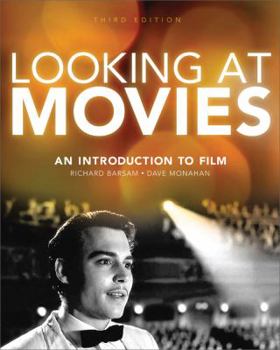
Looking at Movies: An Introduction to Film, 3rd Edition


Select Format
Select Condition 
Book Overview
Looking at Movies is the most effective, engaging, and widely adopted introduction to film analysis available. From its very first chapter, Looking at Movies provides students with all the tools they... This description may be from another edition of this product.
Format:Paperback
Language:English
ISBN:0393932796
ISBN13:9780393932799
Release Date:January 2010
Publisher:Norton & Company, Incorporated, W. W.
Length:600 Pages
Weight:2.75 lbs.
Dimensions:8.0" x 0.6" x 5.0"
Customer Reviews
2 ratings
I have DVDs only. It is smart to collect various editions.
Published by bernie4444 , 2 months ago
Picked up the DVDs in a second-hand store. But they are sufficient to show that this is a useful book, even for the casual movie watcher. It is the equivalent, if not better, of the voice-over commentaries on DVDs that explain what the movie is attempting to portray; that is, even if it does or does not portray it correctly.
Broken down into different forms of a-n-a-l-y-s-i-s, it allows us to step back and see what we may have missed. On the other hand, we can also see what this presentation missed. For example, in evaluating “Juno,” the authors use obscure contemporary movies and one classic to compare. They miss the wider range of comparison movies, such as “People Will Talk” (1951) with Cary Grant.
Moving on to ponder how the view of watching movies expands, but the view of what the movie was about is missed. The presentation contrasts Lord Voldemort with H-i-t-l-e-r but overlooks the many meaningful mythological figures. The narrator draws on other films but overlooks Joseph Campbell's coming-of-age scenario. The physical element in making the film is excellent and gives us the language to express movie-making techniques.
Goes into the difference between narration, narrative, and narrator. Used “The Big Charade” (2003), “Amelie”, and “The Limey” as examples.
Diegetic and non-diegetic Elements. “Death to the Tinman”, “Countdown,” and others.
Suspense and Surprise. “The Great Train Robbery”.
Setting and Expressionism. “The Cabinet of Dr. Caligari”, “Frankenstein”, “Edward Scissorhands”, and others.
Lighting and familiar image. “The Night of the Hunter” (1955).
Composing the Frame. Talking about the Rule of Thirds in framing, eye room in the frame, negative space, and deep space composition. “Lawrence of Arabia” and many more films.
The Lumière Brothers’ “Actualités” (Documentary) 45 seconds.
In the end, it is like someone telling you that your shoe is untied.
Good text book
Published by Thriftbooks.com User , 18 years ago
This is the only book used in my MFA program film course. If you are not into the nuances of making a film or even understanding how to review a film, this is a great first step. It breaks down the film into its parts and once you are done, you will actually look at movies in a new and exciting way. The companion CD is good, if film making is in your future, but wasn't necessary for a group of fiction writers. Even if you are not in a film class and just want to understand the making of films, this is a good reference.
Copyright © 2026 Thriftbooks.com
Terms of Use | Privacy Policy | Do Not Sell/Share My Personal Information | Cookie Policy | Cookie Preferences | Accessibility Statement
ThriftBooks ® and the ThriftBooks ® logo are registered trademarks of Thrift Books Global, LLC
ThriftBooks ® and the ThriftBooks ® logo are registered trademarks of Thrift Books Global, LLC
