


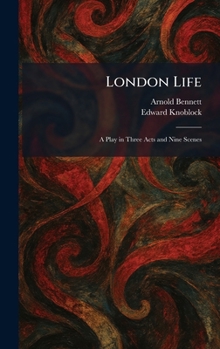
London Life: A Play in Three Acts and Nine Scenes

"London Life a Play in Three Acts and Nine Scenes" is a sophisticated exploration of early 20th-century British society, politics, and the personal cost of ambition. Co-authored by the renowned novelist Arnold Bennett and the accomplished playwright Edward Knoblock, this work offers a panoramic view of the bustling metropolis during a period of significant social transition. The narrative unfolds through nine distinct scenes, meticulously detailing the maneuvers of those seeking power and influence within the upper echelons of London's political and social circles.
The play centers on themes of integrity versus pragmatism, as characters navigate the treacherous waters of public life and private desires. Through sharp dialogue and keen observation, Bennett and Knoblock capture the essence of a London fraught with class tensions and shifting moral landscapes. The collaboration between these two literary figures results in a work that is both a social document of its time and a timeless study of human character. "London Life" remains an essential piece for those interested in the history of British drama and the literary portrayal of the modern city.
This work has been selected by scholars as being culturally important, and is part of the knowledge base of civilization as we know it. This work was reproduced from the original artifact, and remains as true to the original work as possible. Therefore, you may see the original copyright references, library stamps (as most of these works have been housed in our most important libraries around the world), and other notations in the work.
This work is in the public domain in the United States of America, and possibly other nations. Within the United States, you may freely copy and distribute this work, as no entity (individual or corporate) has a copyright on the body of the work.
As a reproduction of a historical artifact, this work may contain missing or blurred pages, poor pictures, errant marks, etc. Scholars believe, and we concur, that this work is important enough to be preserved, reproduced, and made generally available to the public. We appreciate your support of the preservation process, and thank you for being an important part of keeping this knowledge alive and relevant.
Related Subjects
DramaCustomer Reviews
ThriftBooks ® and the ThriftBooks ® logo are registered trademarks of Thrift Books Global, LLC
