


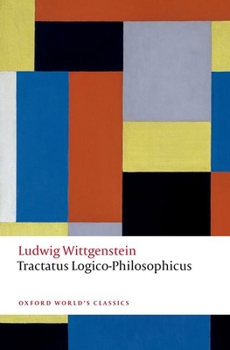
Tractatus Logico-Philosophicus

Select Format
Select Condition 
Book Overview
'what can be said at all can be said clearly; and of what one cannot talk, about that one must be silent' Wittgenstein's Tractatus Logico-Philosophicus, first published in German in 1921 and in English translation in 1922, is one of the most influential philosophical texts of the twentieth century. It played a fundamental role in the development of analytic philosophy, and its philosophical ideas and implications have been fiercely debated ever since. This new translation improves on the two main earlier translations, taking advantage of the scholarship over the last century that has deepened our understanding of both the Tractatus and Wittgenstein's philosophy more generally, scholarship that has also involved discussion of the difficulties in translating the original German text and the issues of interpretation that arise. Michael Beaney's translation is accompanied by two introductory essays, the first explaining the background to Wittgenstein's work, its main ideas and their subsequent development and influence, and some of the central debates, and the second providing an account of the history of the text and the two earlier translations. It is accompanied by detailed notes, explaining key points of translation and interpretation, a glossary, chronology, and other editorial material designed to help the reader understand the Tractatus and its place in the history of philosophy.
Format:Paperback
Language:English
ISBN:0198861370
ISBN13:9780198861379
Release Date:August 2023
Publisher:Oxford University Press
Length:208 Pages
Weight:0.41 lbs.
Dimensions:0.4" x 5.1" x 7.8"
Customer Reviews
3 ratings
How to stop doing philosophy
Published by Thriftbooks.com User , 21 years ago
There's a lot going on in this little book. I take it, though, that at its core the thesis of the book is fairly straightforward (even if controversial): What can be said (i.e. what can be meaningfully uttered, i.e. what can be said in such a way as to have an unambiguous meaning) can be said clearly (i.e. can be said in such a way as to make perfect sense and be easily understood). Nothing else should be said. This has the implication that instead of doing philosophy, we should let scientists do their things, we should talk about things around us ("warm weather today, huh" "There is a red tailed sparrow on the top of that tree!"), and not sully our feeling that there is something more by talking about it in ways that will not make sense. The argument fits nicely with a style of poetry and art that is contemporary with Wittgenstein, that consists of simply painting things as they are seen, and calling attention to the ordinary everyday around you in such a way as to summon its power to astound (e.g. Rilke or Proust). The aim ultimately, for W., is to stop theorizing about things and to just live in the moment. In that way, it is close to Buddhist and other insights. Great book, well worth reading. Not an easy read though.
Seminal
Published by Thriftbooks.com User , 23 years ago
That is the only word to describe this book, even if some of the ideas are erroneous. That is not the only basis to judge a book's importance. His work seems to be an expansion of an aphorism found in Nietzsche's All Too Human, that people have always assumed words have an unchanging meaning, or have meaning at all in some cases. Ludwig compares our language to a mirror, which must represent something in reality to be truthful. This is not a rejection of what is thus deemed "mystical," but in fact is more respectful of it, in freeing it from refutations or proofs based in language. Ludwig perhaps states this better in his later work. He also shows that the idea of an absolute is nonsensical, that something must exist in relation to something else; to prove an absolute you would have to find a symbol that would no longer be a symbol. Not every proposition can be based on the criterion of truth or falsehood. This makes all previous philosophy nonsense. The symbols used are used to say something that cannot be said. His style is impressive in its force and simplicity. The book is an eclectic mix of logical proofs and regular prose. Now whether all philosophy is made suspect by Wittgenstein is debatable. There are some philosophies that do not repeat the previous errors of the Platonic tradition, such as existentialism. In any case, the study of language is profoundly shown to be integral to a full study of philosophy. Some knowledge of logic would be helpful, but not absolutely necessary to understand the import of his main ideas.
A classic with contemporary relevance
Published by Thriftbooks.com User , 27 years ago
Wittgenstein's first published work. Should be as famous for Russell's misunderstanding of it, made obvious in his introduction, as for it's effect on the positivists and modern philosophical logic. Absolutely essential reading for studying Wittgenstein's later work. The Investigations can be read as a refutation of the Tractatus, and thereby, as a refutation of much of contemporary philosophy of language. While Wittgenstein doesn't help his readers with either references or explanatory preamble, the effort of reading this book will be well rewarded to anybody studying contemporary issues in philosophical logic, philosophy of language or philosophy of science. Whatismore, Wittgenstein's poetic style is a joy to read and many of his aphorisms will come back to you in other studies.
Copyright © 2026 Thriftbooks.com
Terms of Use | Privacy Policy | Do Not Sell/Share My Personal Information | Cookie Policy | Cookie Preferences | Accessibility Statement
ThriftBooks ® and the ThriftBooks ® logo are registered trademarks of Thrift Books Global, LLC
ThriftBooks ® and the ThriftBooks ® logo are registered trademarks of Thrift Books Global, LLC
