


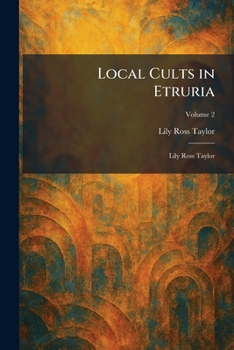
Local Cults in Etruria: Lily Ross Taylor

"Local Cults in Etruria" is a foundational scholarly examination of the religious practices and spiritual landscape of the ancient Italian region of Etruria. In this second volume, Lily Ross Taylor provides a meticulous analysis of the specific deities, rituals, and sanctuaries that characterized the various cities and territories of the Etruscan people. By synthesizing archaeological evidence with classical literary sources, the work reconstructs the diverse religious traditions that flourished before and during the rise of Roman influence.
The study delves into the sacred geography of the region, exploring how local cults shaped community identity and influenced the broader development of Roman religious life. Taylor's rigorous approach offers a detailed look at the persistence of indigenous traditions and the syncretism that occurred as Etruscan culture encountered neighboring civilizations. "Local Cults in Etruria" remains a vital resource for scholars and students of ancient history, archaeology, and the history of religions, providing essential context for understanding the complex cultural heritage of pre-Roman Italy.
This work has been selected by scholars as being culturally important, and is part of the knowledge base of civilization as we know it. This work was reproduced from the original artifact, and remains as true to the original work as possible. Therefore, you may see the original copyright references, library stamps (as most of these works have been housed in our most important libraries around the world), and other notations in the work.
This work is in the public domain in the United States of America, and possibly other nations. Within the United States, you may freely copy and distribute this work, as no entity (individual or corporate) has a copyright on the body of the work.
As a reproduction of a historical artifact, this work may contain missing or blurred pages, poor pictures, errant marks, etc. Scholars believe, and we concur, that this work is important enough to be preserved, reproduced, and made generally available to the public. We appreciate your support of the preservation process, and thank you for being an important part of keeping this knowledge alive and relevant.
Customer Reviews
ThriftBooks ® and the ThriftBooks ® logo are registered trademarks of Thrift Books Global, LLC
