


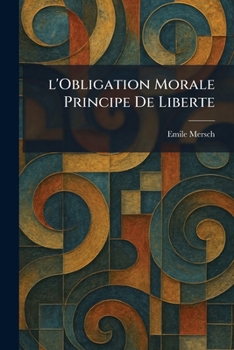
L'Obligation Morale Principe De Liberte

"l'Obligation Morale Principe De Liberte" is a profound theological and philosophical exploration by the renowned Jesuit scholar mile Mersch. In this significant work, Mersch delves into the intricate and often misunderstood relationship between moral duty and human freedom. He challenges the conventional view that obligation acts merely as an external constraint upon the individual will. Instead, Mersch posits that moral obligation is the very principle that enables and perfects true liberty. He argues that by aligning human action with divine and natural law, the individual transcends the limitations of mere whim to achieve a higher state of authentic moral autonomy.
Rooted deeply in the Catholic intellectual tradition, the text provides a rigorous and systematic analysis of conscience, the nature of law, and the ontological foundations of ethical behavior. Mersch's insights reflect a compelling synthesis of scholastic precision and spiritual depth, characteristic of his broader contributions to 20th-century thought. This volume serves as a vital resource for scholars of Christian ethics, theologians, and philosophers interested in the reconciliation of moral authority with the exercise of free will. "l'Obligation Morale Principe De Liberte" stands as a testament to Mersch's intellectual legacy, offering a timeless perspective on how the pursuit of the good constitutes the highest expression of freedom.
This work has been selected by scholars as being culturally important, and is part of the knowledge base of civilization as we know it. This work was reproduced from the original artifact, and remains as true to the original work as possible. Therefore, you may see the original copyright references, library stamps (as most of these works have been housed in our most important libraries around the world), and other notations in the work.
This work is in the public domain in the United States of America, and possibly other nations. Within the United States, you may freely copy and distribute this work, as no entity (individual or corporate) has a copyright on the body of the work.
As a reproduction of a historical artifact, this work may contain missing or blurred pages, poor pictures, errant marks, etc. Scholars believe, and we concur, that this work is important enough to be preserved, reproduced, and made generally available to the public. We appreciate your support of the preservation process, and thank you for being an important part of keeping this knowledge alive and relevant.
Customer Reviews
ThriftBooks ® and the ThriftBooks ® logo are registered trademarks of Thrift Books Global, LLC
