


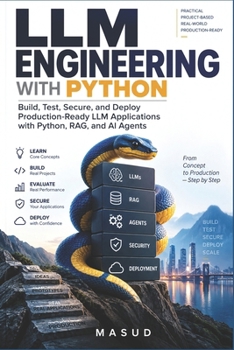
LLM Engineering with Python: Build, Test, Secure, and Deploy Production-Ready LLM Applications with Python, RAG, and AI Agents

Includes a complete companion GitHub repository with the book. Get the source code, tests, prompts, evaluation datasets, documentation, and hands-on project implementations at github.com/masud-dot/llm-engineering-with-python. You can follow the book chapter by chapter, run the examples, inspect the tests, and build on the same engineering patterns used throughout the book.
Large language models can produce impressive results in a prototype. Turning that prototype into a reliable application is a different engineering problem.
LLM Engineering with Python takes you from working API calls to production-oriented systems that are designed to be tested, evaluated, secured, observed, and deployed.
You will learn how to:
Learn by building real projects.
The capstone section brings the engineering concepts together through practical applications, including an AI Document Assistant, AI Test-Case Generator, AI SQL Assistant, AI Research Agent, and a production service that assembles the components into a deployable system.
This book also emphasizes something often missing from LLM tutorials: measurement and verification. You will learn to distinguish software testing from model-output evaluation, measure retrieval quality, validate security controls, track cost and latency, and build quality gates that can detect regressions.
Who is this book for?
This book is designed for Python developers, software engineers, QA and automation engineers, backend developers, AI/ML engineers, and technical professionals who want to move beyond LLM experimentation and understand how production-grade AI applications are engineered.
You should be comfortable reading and writing Python. No previous experience building LLM applications or advanced machine-learning background is required.
Stop treating the LLM as the entire application. Learn how to engineer the system around it.
Customer Reviews
ThriftBooks ® and the ThriftBooks ® logo are registered trademarks of Thrift Books Global, LLC
