


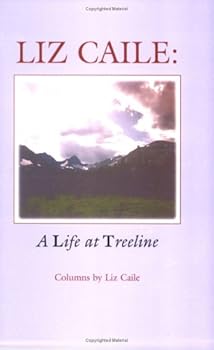
Liz Caile : A Life at Treeline

A reporter and columnist for The Mountain-Ear newspaper in Nederland, Colorado, for 20 years, Liz Caile spent her entire life in the Front Range of the Rocky Mountains, building relationships with... This description may be from another edition of this product.
Format:Paperback
Language:English
ISBN:0970253206
ISBN13:9780970253200
Release Date:October 2000
Publisher:Perigo Press
Length:242 Pages
Weight:0.75 lbs.
Dimensions:0.7" x 5.4" x 8.3"
Related Subjects
NatureCustomer Reviews
1 rating
Awe-inspiring views from the treeline.
Published by Thriftbooks.com User , 24 years ago
"I want my stories to come from places and things I know in nature," Liz Caile writes. "I want to take some of my craziness and bury it ritually in the right place in the earth, to find a cure for my restlessness in plants and planets, roots and rituals" (p. 50). Before her death, Caile wrote for "The Mountain Ear" in Nederland, Colorado, a mountain town in the Rockies just west of Boulder (where I live). This book is a collection of the columns Caile contributed to that newspaper for twenty years. These essays are about living an authentic life, walking softly, and living simply.Caile was a minimalist who practiced what she preached. "People should adapt to nature, rather than the other way around" (p. 49), she writes. She lived in a primitive mountain cabin, and prefered walking to driving a car. "So my kids learned to walk, a skill that will be one of the most valuable things I taught them," Caile says. "You can always get from here to there on your own two feet" (p. 6). She considered pavement a "form of imprisonment" (p. 103), and encourages her readers to walk. "If you live in town, walk at least to its edge, and better yet, beyond it" (p. 234). "I pray with my feet," she says. Her loving friends tell us that Liz "believed in living lightly on the earth, in using our resources carefully and thoughtfully. She believed in being conscious of the impacts of our actions, as a nation and as individuals" (p. v). The Sierra Club cup represents an ideal for Caile. "Let's face it," she writes, "the fewer dishes you dirty, the fewer you have to wash. It represents an economy of utensils that I wish we all could take into our lives. It says some basic things about our habit of consumption, drawing a line between what we really need and what is superfluous" (pp. 9-10). In her essays, Caile urges us to simplify our lives, to "act with responsibility to all species, not just ourselves" (p. 124), to commune with the power of nature, then vote, run for office, read about the issues, write and make phone calls (p. 96).Caile's essays are organized into sections on simple living, changing seasons, environmental ethics, social values, war and peace, life at treeline, family, and walking. Each essay reveals her knack for seeing the extraordinary in the ordinary. "What counts is the seeing," she reflects. "I don't know what it is," she writes, "except that if everyone were to discover the pleasures of just looking at things and listening to things, they'd probably stop spending money at breakneck speed--they might even stop working at certain jobs that, when clearly observed, appear to be counterproductive to a healthy society" (p. 14). "A moth," she confides, "only a moth, brings life to my life" (p. 73).Caile wrote with integrity and courage. She was progressive even by Nederland and Boulder standards, confronting subjects including overpopulation, pavement, mountain bikers, mall shopping, advertising, pollution, consumption, species loss
Copyright © 2026 Thriftbooks.com Terms of Use
| Privacy Policy | Do Not
Sell/Share My Personal Information | Cookie Policy | Cookie Preferences | Accessibility Statement
ThriftBooks® and the ThriftBooks® logo are registered trademarks of Thrift Books Global, LLC
ThriftBooks® and the ThriftBooks® logo are registered trademarks of Thrift Books Global, LLC
