


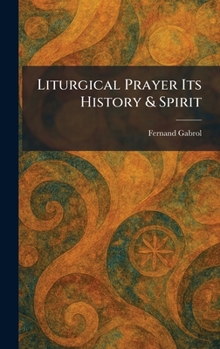
Liturgical Prayer Its History & Spirit

"Liturgical Prayer Its History & Spirit" is a comprehensive and scholarly exploration of the evolution and essence of Christian worship. Written by the renowned liturgist Fernand Cabrol, this work delves into the origins and development of the various forms of prayer used within the Church. It provides a detailed historical overview of the liturgy, examining its roots in tradition and its subsequent transformation through the centuries.
The book goes beyond mere historical analysis, seeking to uncover the underlying spirit and theological significance of liturgical practices. Cabrol illuminates the beauty and depth of the Divine Office, the Mass, and the sacramental rites, illustrating how they serve as the communal voice of the faithful. Readers will find insightful reflections on the liturgical year, the significance of psalms, and the structural elements of public worship. This classic text remains an essential resource for those seeking to understand the heritage of Christian prayer and the profound spiritual treasury contained within the liturgical life of the Church. It is particularly valuable for students of theology, historians, and anyone interested in the ritual foundations of faith and the development of the Catholic tradition.
This work has been selected by scholars as being culturally important, and is part of the knowledge base of civilization as we know it. This work was reproduced from the original artifact, and remains as true to the original work as possible. Therefore, you may see the original copyright references, library stamps (as most of these works have been housed in our most important libraries around the world), and other notations in the work.
This work is in the public domain in the United States of America, and possibly other nations. Within the United States, you may freely copy and distribute this work, as no entity (individual or corporate) has a copyright on the body of the work.
As a reproduction of a historical artifact, this work may contain missing or blurred pages, poor pictures, errant marks, etc. Scholars believe, and we concur, that this work is important enough to be preserved, reproduced, and made generally available to the public. We appreciate your support of the preservation process, and thank you for being an important part of keeping this knowledge alive and relevant.
Customer Reviews
ThriftBooks ® and the ThriftBooks ® logo are registered trademarks of Thrift Books Global, LLC
